For banks, hyper-personalisation is becoming as much of an opportunity as an obligation in a market exploding with neobanks and risks linked to fraud. To achieve this, you need to know your customer well. Very well, in fact. Datastax and JEMS offer two keys to success in achieving this.
Qu'est-ce que l'hyperpersonnalisation ?
As consumers, we want offers that meet our immediate needs. This is even a permanent need seeing as our digital daily lives are so invaded by advertising cookies and other personalisation algorithms: e-commerce purchases, video streaming and recommendations, music curation, etc. Hyper-personalisation in marketing means addressing the right message to the right person at the right time.
In a study published in 2020, «Trends in financial services »Salesforce tells us that 55% des gens ne commencent à considérer une offre que si celle-ci est personnalisée. 66% of customers also expect financial institutions to understand their needs and expectations. Thomas Been Datastax CMO explains:
«There is genuine customer expectation. They no longer want intermediaries and want an immediate impact. This is all the more true with services like payments or cryptocurrencies. These offerings must take into account the value for the customer as well as their financial health. The financial services company must understand the customer and act as a partner.
Customer knowledge: a requirement for achieving hyper-personalisation
There is a paradox to overcome. Financial services firms need to establish a trusting relationship with clients at a time when clients have less and less trust in the financial system. However, it is with hyper-personalisation that this situation will be resolved. Knowing the client's context allows them to be positioned with an on-demand offering and to respond to their needs in real time.
Car Client knowledge leaders use all data to understand them. not only contractual data stored in a data warehouse but also that coming from applications arriving in real time. Starbucks, for example, continuously pushes extremely targeted offers, which has considerably boosted its sales.
But to truly know your client, the reference framework is no longer enough. The approach must be comprehensive. We are increasingly seeing the addition of operational data to customer repositories, with the desire to merge the two worlds. The problem is that the pace of a customer repository is slow: it takes time to verify information and figures. But customers no longer want to wait that long.
If CIOs continue to rely solely on their repository, not all data will be leveraged, and this risks leading to inaccurate customer knowledge, which will result in errors in the offers proposed and an increasing attrition rate.
How to implement this customer relationship hyper-availability?
Pascal Dury, VP of data management at JEMS explains. «There are two keys to success: having a well-established MDM methodology and adopting a Data Centric, rather than Data Driven, approach. Both are absolutely necessary.
- Key to success #1: apply the MDM treatment method. This is about collecting, cleaning, and identifying all the data, and creating a Golden Record as clean as possible at a given moment. Then this 360° view of the customer is completed by enriching it with all known elements: contract, loan, interaction. One of the joint projects between DataStax and JEMS for the bank of a car manufacturer was to move from an SI based on contracts to a vision centered on the person. The driver becomes Mr. Martin or Ms. Park, and no longer a contract number.
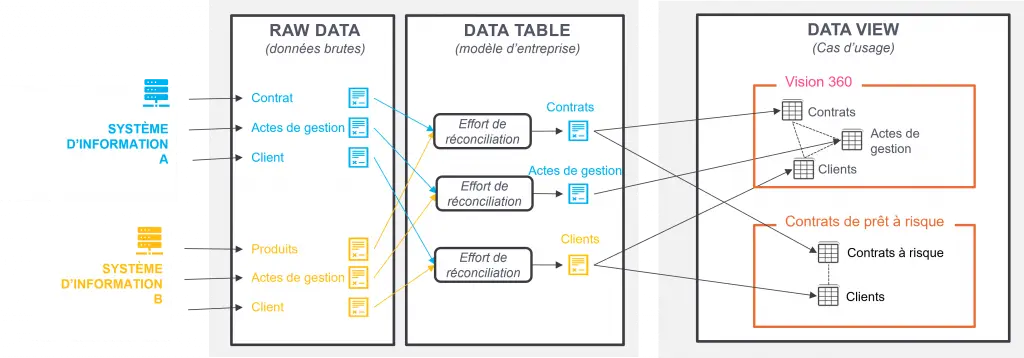
- Key to success no. 2: The Data Centric approach. This is how we are going to model the banking institution's data. When working on a use case (a new offer, for example), we will take data from different systems and reconcile it to create a use case. If another use case is requested, we repeat the entire reconciliation protocol.
To be Data-centric We will only have to do this reconciliation once. This translates to delivering use cases 3 to 5 times faster.
Hyper-personalisation is a necessity for financial services. Their customers want short response times and real-time interactions. IT departments need a system with solid, scalable foundations to manage on-demand use cases and to be able to scale up with additional data from real-time sources.
To find out more
About DataStax : Established in 2010 in California to support Apache Cassandra. Datastax has contributed to the Cassandra, Pulsar, and Kubernetes open-source communities. Datastax has over 500 enterprise clients worldwide, including American Express, CapitalOne, Euronext, Fidelity, RBC, US Bank, and Visa.
About JEMS: JEMS is a data industry firm whose business is to create and enhance clients' data assets. With over 450 data and digital projects, JEMS has a presence in 13 major cities in France and internationally.