With the advent of Industry 5.0, connected objects are becoming even more indispensable to meet new use cases. as they bring the «on-the-ground» vision essential for achieving this industry’s objectives: connected, resilient, sustainable, and human-centric.
Industry 5.0: A New Era for Industry
In January 2021, the European Commission laid the groundwork for a new era for industry: Industry 5.0.
Complementing the concept of Industry 4.0, which focused on technological innovation and connectivity, Industry 5.0 adds consideration for worker well-being, sustainability, and resilience.
As such, Industry 5.0 complements and extends Industry 4.0. It focuses on aspects that will be decisive, not just economic or technological, for the place of industry in future European society. These factors also have environmental, social, and fundamental rights dimensions. Thus, Industry 5.0 should not be understood as a chronological continuation or an alternative to the existing paradigm of Industry 4.0, but rather as a natural and enriching evolution.
Busting the silos of connected objects
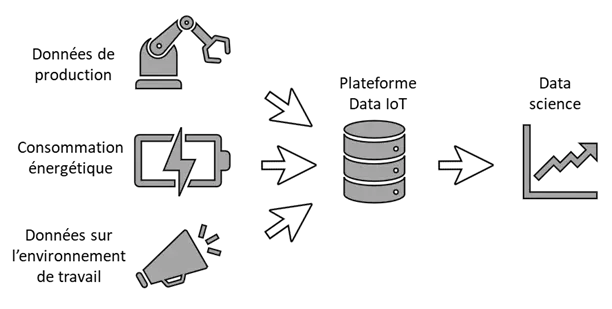
Our conviction is that, even more so than with Industry 4.0, Industry 5.0 will require connected objects reporting measurements from the field to efficient data platforms capable of «mixing» data from different domains (industrial production, energy performance, working environment, etc.) to extract maximum value and learning.
Indeed, if Industry 4.0 still accepted data processing in silos, it is clear that the objectives of 5.0 require breaking down these silos to bring them together in order to respond to new use cases through relevant data science processing (examples: what is the relationship between my industrial production and my energy consumption? What is the relationship between the quality of my production and the quality of my work environment? etc.).
Removing data silos to address Industry 5.0 use cases.
IoT Data-Centric Platforms
To address these new use cases, it is therefore essential to implement data platforms capable of effectively integrating the telemetry flows generated by the connected objects of this new industry.
Industrial IoT 5.0 (IIoT 5.0) must therefore be seen and implemented as an indispensable data source for achieving these use cases.
At JEMS, this conviction is embedded in our approach to designing industrial data assets. IIoT flows are viewed as data sources that enter the data platform and are brought together in a single space, allowing them to be cross-referenced with all other data sources. This enables us to address all current or future use cases, which is our «Data Centric» approach to industrial asset data.
This conviction, which unifies our approach to data modelling, guarantees the construction of an IIoT data platform that is evolvable, scalable, and significantly reduces technical debt.