Home » News » The impact of generative AI on IT infrastructure
The impact of generative AI on IT infrastructure
Published on
«Generative AI and its possibilities» (4/5) . Artificial Intelligence has brought about considerable changes to IT infrastructure, transforming the way we store, process, and use data, and necessitating the management of new artefacts: the models themselves and everything that revolves around them. In this article, we will explore the main evolutions that AI has introduced in the field of IT infrastructure.
The data storage revolution in the post-Big Data era
AI has spawned a massive need for data storage. Pre-trained AI models, such as the well-known GPTs (Generative Pre-trained Transformers), require colossal amounts of data for their training. This has led to the adoption of cloud storage solutions, distributed databases, and high-speed storage systems to meet this growing demand.
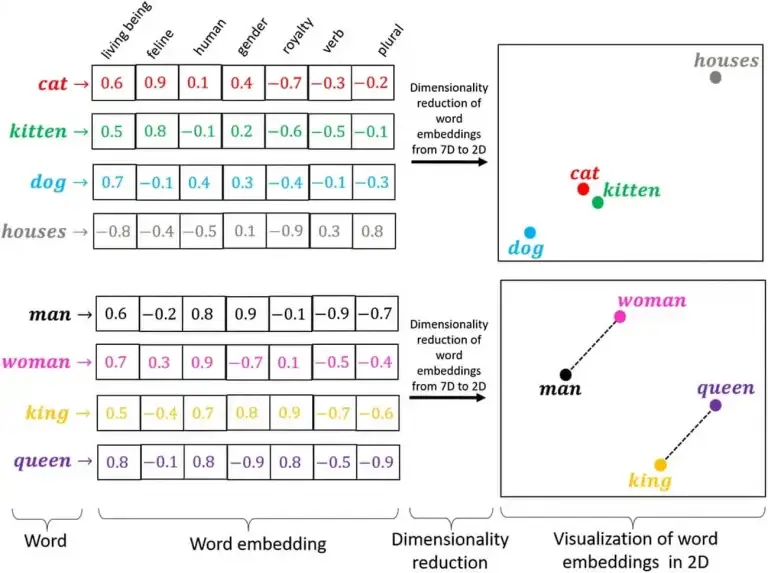
What impact has this had on Big Data architectures? The nature of the data to be stored and its indexing. Indeed, as we explained to you in our previous article (Generative AI: be careful not to give it just anything!), in most cases, the aim is to produce / predict the next item in a sequence of items Word, pixel, sound, etc. To predict the next one, it is necessary to be able to mathematically compare one element with another.
The mathematical synthesis of each element is a simple vector that integrates all of the element's descriptive statistics. As an example, a word's vector would be a list of probabilities of that same word occurring compared to all others. Thus, each word has its probability vector relative to all others. The very nature of a vector, which is neither a simple INT nor a CHAR:
Word Embeddings, H. Gautam
And thus creating the need to specifically store and index this new type of data. Thus emerged Vector databases. They have the particularities of being very flexible, implementing vector-specific calculation functions (cosine, Euclidean distances, etc.) and requiring a bit more CPU than classic databases.
Computing power and specialised processing units
One of the most notable developments is the exponential increase in computational power required. AI algorithms, such as those used in deep learning, require considerable processing capabilities to train and deploy high-performing models. To meet this demand, companies have invested in Graphics Processing Units (GPUs) and Tensor Processing Units (TPUs) specifically designed to accelerate AI-related calculations. Consequently, companies producing this computing power have seen their revenue double from 2022 to 2023 (117% for NVIDIA). The emergence of new, even more specialised computing units, optimised according to learning algorithms, is currently being tested. There is no doubt that, given the amounts involved and the speed of obsolescence, it is preferable to turn to cloud AI Computing rather than bearing all these hardware evolutions.
Thus cloud computing has become a pillar of IT infrastructure In the context of AI. Cloud providers are now offering AI-specific services, providing scalable computing resources for model training and deployment. This approach has allowed businesses to reduce costs and gain flexibility.
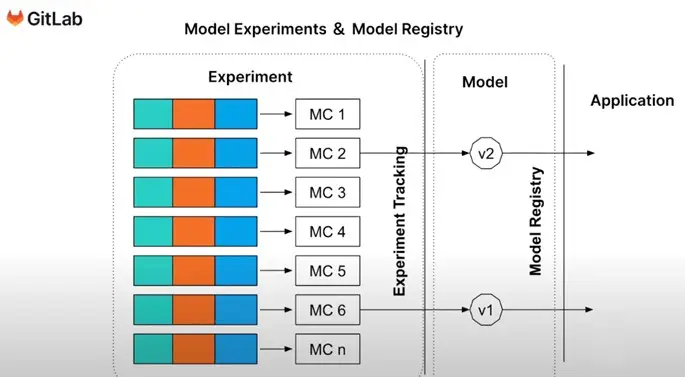
Beyond computing power, the management and indexing of new AI-related artefacts has led to the emergence of new services among the actors already dominant in the market. The case of GitLab is very interesting as it is one of the leaders in terms of versioning and CI/CD tools. GitLab had to evolve its indexing technology and its operating principle to be able to associate the notion experiment is inherent to the exploration stage in a Data Science project. Gitlab has also integrated logic for managing validated models following the experiments in a dedicated space, the model registry which facilitates and secures the entire process of putting these models into production, the ML OPS process.
Gitlab 16.3.1 MLOps New CI
In short, Artificial intelligence has brought about radical changes to IT infrastructure.. The computational power requirements, data storage needs, adoption of cloud computing and the changing operating principles of major tools are all revolutions that have redefined how businesses manage their IT resources.
To remain competitive in this new technological ecosystem, organisations must continue to adapt and invest in scalable and flexible IT infrastructure, while fully leveraging the potential of AI to drive innovation and growth.
To provide the best experiences, we use technologies such as cookies to store and/or access device information. Consenting to these technologies will allow us to process data such as browsing behaviour or unique IDs on this site. Not consenting or withdrawing consent may adversely affect certain features and functions.
Functional
Always active
Technical access or storage is strictly necessary for the legitimate interest of enabling the use of a specific service explicitly requested by the subscriber or user, or for the sole purpose of carrying out the transmission of a communication over an electronic communications network.
Preferences
Technical access or storage is necessary for the purpose of legitimate interest in storing preferences not requested by the subscriber or user.
Statistics
Storage or technical access that is used exclusively for statistical purposes.Technical storage or access used exclusively for anonymous statistical purposes. Without a subpoena, a voluntary compliance from your Internet Service Provider, or additional records from a third party, the information stored or accessed for these sole purposes generally cannot be used to identify you.
Marketing
Technical access or storage is required to create user profiles for advertising, or to track the user on a website or across multiple websites for similar marketing purposes.