

Home » Expertises » Cloud computing
Cloud computing
Build a secure, scalable, and governed cloud foundation to accelerate data platforms, digital uses, and AI.
Cloud computing refers to the on-demand use of technological resources such as storage, databases, computing power, analytics, and networking. In our model, it corresponds to the design and implementation of the foundations of the data platform and, more broadly, the technological base required for digital applications and services.
The challenge is no longer just about moving workloads to a cloud provider. It's about defining a coherent strategy that can modernise architecture, secure environments, industrialise deployments, and ensure governance that complies with constraints of conformity and sovereignty. It is this combination of performance, agility, security, and control that makes the cloud a strategic issue today.

Cloud computing has become a major driver of transformation because it allows organisations to break free from the traditional limitations of their on-premise infrastructures. Applications now need to evolve faster, absorb load variations, remain continuously available, and integrate with increasingly demanding data platforms or analytical services. In this context, the cloud offers an adaptability that is difficult to achieve with rigid infrastructures or those heavily constrained by hardware renewal cycles.
But adopting the cloud isn't simply about migrating servers. The simplest approaches, particularly when they involve an almost identical transfer of existing systems, quickly show their limitations. They can retain unnecessary dependencies, generate additional costs, complicate operations, and limit the expected benefits in terms of scalability, resilience, or automation. This is why an effective cloud strategy requires genuine architectural modernisation.
This strategy must also take into account the diversity of possible models. There are four main cloud architectures: full cloud, multi-cloud, Private hybrid and Hybride on-premise. The right choice depends on the application context, operational constraints, data criticality level, and the company's development objectives.
Data sovereignty now becomes a central issue. An organisation can no longer reason solely based on technical capability or cost. It must also master the location of its data, access conditions, processing responsibilities, regulatory requirements, and legal or contractual dependencies related to its suppliers. A modern cloud strategy must therefore articulate agility and control, performance and compliance, technological openness and protection of its information assets.
In this vein, the cloud is not simply a hosting method. It becomes a structuring foundation for applications, data platforms, analytical environments, and future artificial intelligence uses. When well-designed, it allows systems to be industrialised, secured, and scaled without creating new technical debt.
How does this expertise translate at JEMS?
At JEMS, cloud computing is approached as a strategic, technical, and economic foundation, designed to support the performance, governance, and sustainable evolution of information systems.
With this approach, we are not just implementing a cloud platform. The aim is to build a modernised, measurable, governed environment that is truly useful to applications, data, and business units.
Audit
We analyse the existing situation, applications, data volumes, operational constraints and business expectations to define a realistic cloud trajectory. Deliverables are presented at the end of the service, such as the audit report and the FinOps study for cost optimisation.
Architecture
We assist in choosing the right architectural model, whether it's IaaS, PaaS, SaaS, hybrid cloud, or another scheme suited to the context. We offer advice on the economic model, the choice of technical architecture, and expected service levels.
Migration
We assist with migrations from one provider to another or from on-premises to the cloud, avoiding overly mechanical approaches that merely shift constraints without genuine modernisation. Among our cloud services, you'll find, for example, migration between providers or from on-premises.
Governance
We are integrating data sovereignty, security, compliance, deployment automation, and performance management into the cloud trajectory, ensuring the foundation remains operable, controlled, and sustainable over time.
Business Value
A well-managed cloud strategy allows an organisation to move faster without losing control. It improves the ability to deploy, scale and secure applications, while giving teams more flexibility to absorb load variations, performance needs and new uses.
It becomes a particularly valuable asset when linked to a logic of governance, economic steering, and sovereignty. The cloud then ceases to be a mere infrastructure choice and becomes a lever for agility, resilience, and transformation.
Applications and platforms are evolving faster, without waiting for long hardware cycles.
Resources are more finely adjusted to the actual needs of the business.
Environments are becoming more resilient, available and automated.
Data and AI projects have a more suitable foundation for scaling up.
The risks associated with data compliance and localisation are better managed.
Cloud decisions are driven with greater visibility on costs and dependencies.
VISION & PERSPECTIVE
In the coming years, cloud computing strategy will continue to become more sophisticated. Organisations will no longer just seek to migrate, but to constantly arbitrate between performance, cost, security, automation, and sovereignty. Hybrid architectures, controlled multi-cloud logic, and specialised environments for data and AI will take up more space, as regulatory constraints and control needs intensify.
Data sovereignty will become a fully fledged design criterion. It will influence choices of hosting regions, partners, governance models, and workload segmentation. In parallel, automation, FinOps, cloud pipelines, and integrated security mechanisms will become expected standards. For JEMS, the cloud must therefore be conceived as a sustainable foundation, capable of reconciling architectural modernisation, industrialisation, and control of information assets.

TO GO FURTHER...

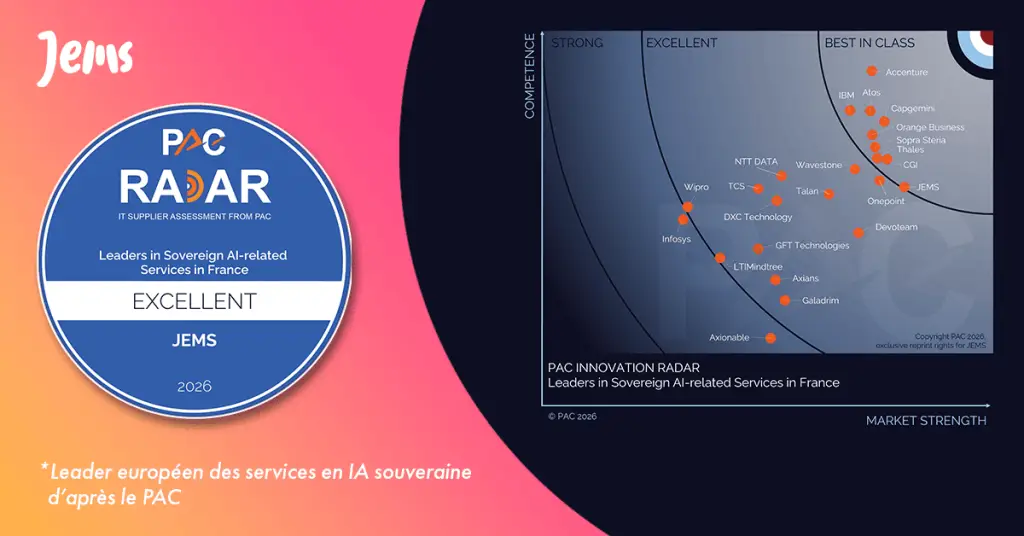
Blog article
Sovereign AI: a business, regulatory and strategic challenge for French companies
FAQ
What is cloud computing?
Cloud computing refers to the on-demand use of resources such as storage, databases, computing, analytics, and networking. JEMS presents it as the foundation of its data platform.
Pourquoi une stratégie de cloud computing est-elle importante ?
Because it allows infrastructure choices to be aligned with business needs, agility objectives, security, costs, and governance constraints.
What is data sovereignty in the cloud?
This is the ability to control where data is hosted, who accesses it, under what rules, and within what legal or regulatory framework.
Quels sont les principaux types d’architecture cloud ?
JEMS distinguishes four main models: full cloud, multi-cloud, private hybrid, and on-premise hybrid.
Is the cloud purely a technical subject?
No. It also impacts the business model, compliance, security, governance, team organisation and the speed of project execution.
Why entrust this subject to JEMS?
Because JEMS combines FinOps consulting, audits, architectural choices, migration, cloud platform implementation, and SI integration in a coherent and pragmatic approach.
Cloud computing is much more than an infrastructure change. It is a transformation of the technological foundation that allows for the modernisation of architectures, acceleration of projects, industrialisation of deployments, and better support for data platforms and future uses. When it integrates data sovereignty, governance, and economic management, this transformation becomes a sustainable lever for performance and trust. At JEMS, this logic is part of a structured, pragmatic, and results-oriented approach.
Modernising your cloud without losing control of your data
Discuss with a JEMS expert to define a cloud computing strategy tailored to your architectural, sovereignty, performance and scaling challenges.