Of the entire economic value that AI generates today, 74 % comes from % 20 companies. The figure comes from the AI Performance Study by PwC (2026). For the rest, the impact on the accounts remains difficult to determine.
The executives themselves say so. In PwC’s 29th Global CEO Survey, 56 % of them declare that they have not observed either an increase in revenue or a decrease in costs related to AI. KPMG’s Global AI Pulse lists only 8 % organizations that have achieved an established return on investment at the enterprise level.
Both groups have access to the same models. What separates them is the ability to deploy AI in processes at scale with measurable impact. For a board of directors, AI industrialization has become the topic of 2026. It requires reliable data, a design that is intended to last, and decisions that are made at the leadership level, well beyond the technical teams.
Why is the industrialization of AI still blocked?
There is no shortage of money. In France, 109 billion euros in private investment in AI was announced in February 2025, during the Summit for Action on AI. French companies’ spending on AI solutions increased by 430% % between 2023 and 2024, according to data provided by Spendesk. However, according to the Insee, only 10 % of the companies with 10 or more employees used at least one AI technology in 2024.
The roadblock lies between the trial and the commercialization phase. According to IDC and Lenovo, 88 % of the AI proof-of-concept (POC) projects do not reach large-scale deployment. Astrafy estimates that only one-third of the projects reach production.
Economists know this discrepancy under the name of the Solow paradox: a technology may take years to appear in productivity figures. In most companies, AI is added to processes that have not changed. The gains remain local, sometimes invisible at the group level.
The cycle is nothing new. Gartner places AI in its «deception trough,» a phase already traversed by big data, the cloud, or blockchain. Agentic AI is on the same trajectory: Gartner predicts the abandonment of more than 40 % of these projects by the end of 2027.
To this is added a bias in management. Many boards of directors still follow the number of POCs launched, an indicator that measures activity rather than value. When we look closely at projects that fail, the causes lie in the organization much more than in the technique.
Blockage | What we observe | Consequence |
Improper usage cases | The AI is launched before the business problem is defined | Generic projects, with little differentiation |
Data base vulnerable | Fragmented data, poorly accessible, poorly governed | Models that are ineffective or limited to a few uses |
Fragmented architecture | Stacking of solutions, partial integration | Expensive, slow, or impossible scaling |
Late governance | Security and compliance handled afterwards | Projects blocked before production begins |
Absent economic management | Success measured by the number of projects | Dispersed resources, late arbitration |
Organization in silos | Trades, IT, data and compliance work in sequence | Isolated initiatives, difficult to replicate |
Source: Report «Data & AI: The Missing Link», 2026.
Industrialization of AI: what gets decided in the board of directors
None of these blockages are resolved within an isolated data team. They are the result of management arbitrations.
The first concerns data. According to Gartner, 63 % of the organizations do not have, or do not know if they have, the data management practices necessary for AI. In the Fivetran 2025 AI & Data Readiness Report, % 77 organizations consider data management critical. A well-designed model based on scattered data produces results that no one uses. Data must therefore be funded and managed as infrastructure, rather than being treated as a technical prerequisite at the end of the project.
The second concerns design. A project conceived for demonstration is almost completely rebuilt at the time of going into production. The most advanced organizations plan from the outset an architecture capable of scaling up, with security and compliance integrated into the framework. Accenture observes that 97 % of the most advanced companies have developed at least three foundational data and AI capabilities.
The third aspect concerns the management of the project. An AI project is judged on a business indicator set before its launch: cost avoided, reduced time, generated turnover. The accuracy of the model says nothing about what it actually generates in terms of revenue.
For a management committee, this translates into five decisions:
- Driving the AI program with measured impact, not the number of projects launched; ;
- Focusing resources on a few high-value use cases rather than a dispersed portfolio of POCs; ;
- First invest in the data foundation, the architecture, governance and exploitation; ;
- Bringing together the business, IT, data, security, compliance and finance departments from the very start; ;
- Regularly measure the maturity of the organization to identify what is hindering industrialization.
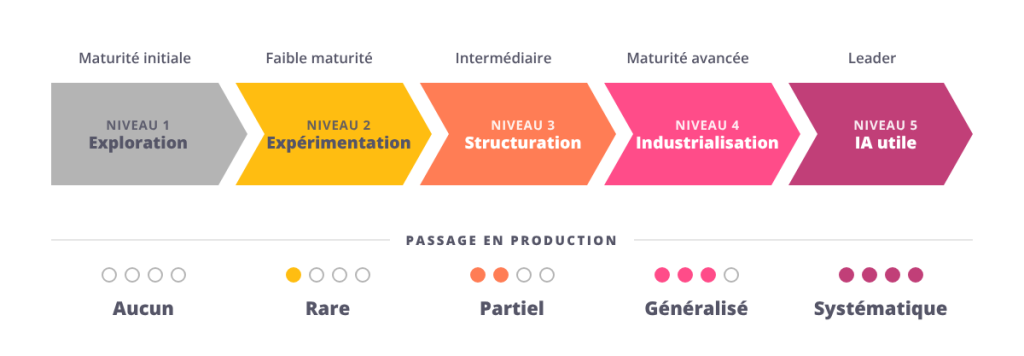
The report «Data & AI: The missing link» contains a maturity matrix across 8 dimensions (data, use cases, architecture, scaling, governance, value management, organization, operability) to place your organization at each level.
Evaluate your data-AI maturity
Our reading: value comes from the system, not the model
According to the activity reports of the CAC 40 groups, AI is present almost everywhere. Three trajectories are emerging. The majority uses it to optimize the existing: stocks, business processes, industrial yields, fraud detection. Others, such as Capgemini, Dassault Systèmes, L’Oréal, Orange or Publicis, invest in platforms and proprietary assets. A third category mobilizes AI for R&D and simulation.
These groups do not differ in their adoption rate. The most advanced know how to link data, architecture, governance and usage in a system that works on a daily basis.
We call this useful AI: AI based on a reliable data foundation, designed for scale, governed from the outset and driven by value. The number of use cases and the sophistication of the models are of little importance in this sense. Its criterion is simple: produce measurable results that are repeatable from project to project and sustainable over time.
Before the next POC, measure its maturity
The dividing line no longer runs between companies that adopt AI and those that do not. It separates those that accumulate experimentation from those that know how to exploit it. For a management committee, the question becomes: under what conditions can we scale up AI and prove what it brings?
The answer rarely starts with the choice of a model. It starts with a clear understanding of the data, the architecture, and the governance.
This is the subject of the JEMS report «Data & AI: the missing link». It details the obstacles to industrialization observed in the market and proposes a matrix to identify your investment priorities before launching the next project.
JEMS Data & IA 2026 report