July 2022. The driest month ever recorded by Météo France since 1958 (when records began). Fires, extreme heatwaves, almost no rainfall... We are in the midst of a climate crisis. Despite this, projects are emerging to help us meet our water needs. These are based on the concept of data heritage with «industrial-type» exploitation to rapidly deliver use cases. Because the urgency is real.
A look back at the challenges of water and its preservation
Water is at the heart of health and food security issues that influence the well-being and peaceful coexistence of people worldwide. 78% des activités humaines dépendent de l’eau domestic, industrial, irrigation and livestock uses, with and without consumption. However, we all observe that water stress, meaning the ratio between total water abstraction and available surface and groundwater reserves, continues to increase.
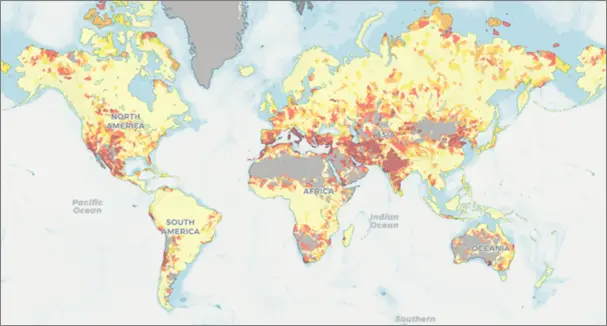
We see this with the tool « Aqueduct » According to the WRI (World Resources Institute), a considerable number of countries are experiencing water stress. These are the red and orange zones where competition for water availability becomes strong. This includes Europe. This includes France.
Water stress can therefore lead to human and commercial conflicts, particularly between industrial and agricultural users who depend on water supply for their production.
Who uses water?
Water is a resource shared among several stakeholders: agriculture, industry, local authorities, and domestic use. If we are to adapt our practices to avoid water stress, data becomes fundamental. Not simply to monitor usage in a dashboard but to To understand, anticipate, predict, and adapt our uses. This is where the concept of data heritage becomes particularly important. Here are some intended use cases:
a) automatic water meter reading for instant management for private individuals and professionals;
b) Instant mobile alerts for network leaks or irregular water consumption;
c) Sharing of Agri-meteo information to anticipate climate hazards and optimise distribution;
d) Issuing an advisory bulletin to optimise public irrigation.
The JEMS Project and Canal de Provence Company
JEMS is a data industrialist. We build factories for generating use cases from all of a company's data. This data constitutes a real asset that must be preserved.
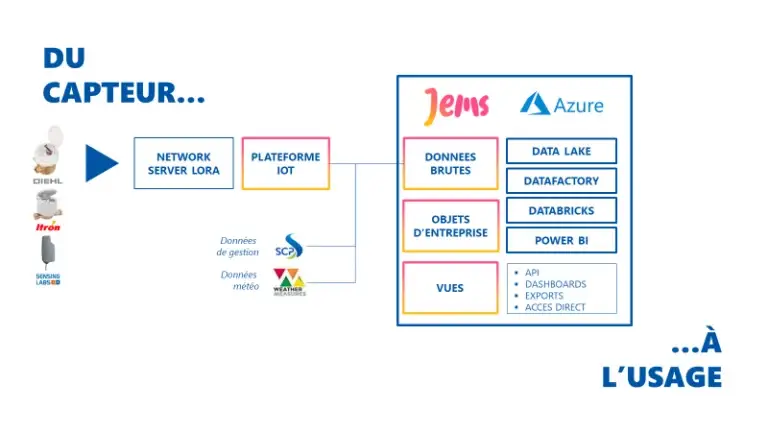
The JEMS & SOCIETE CANAL DE PROVENCE project, which lasted 10 months, involved 4 to 6 people in a genuine partnership. The objective was to deploy a DATA-IOT factory that blends The best of both worlds. On one side, data collected by 70,000 sensors, mixed with weather data and internal data. On the other, an Azure cloud platform to receive and exploit this data in order to deliver on-demand use cases in a truly industrial approach. The advantage?
No technical debt and delivery to market three times faster than any data warehouse solution.
In conclusion
This model has enabled the creation of use cases for networks, such as remote meter reading and emergency situation management, as well as services for individuals – consumption monitoring – and for farmers with personalised irrigation bulletins.
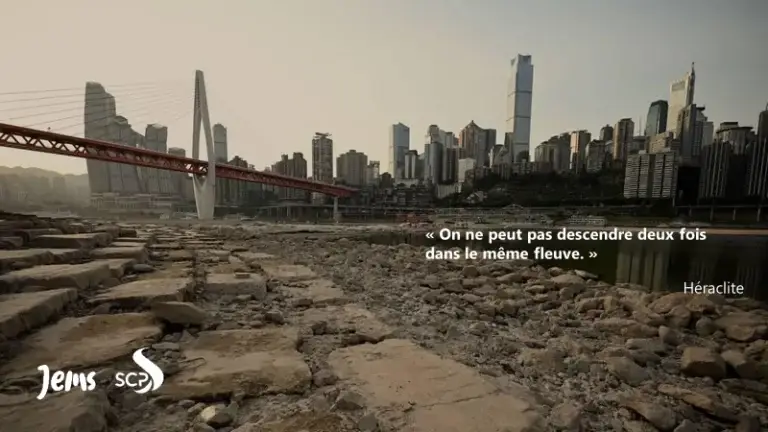
Like a river, which appears always the same yet where the water is never the same, we change, as do things. This is why we cannot live the same thing twice, says the philosopher Heraclitus. The world is in perpetual movement and change..
At JEMS, we also believe that we cannot go back and that human activity has significantly disrupted the climate. But we are doing our part. The data and the importance of using this heritage can help us to better regulate our behaviour and change our habits.