Everyone knows La Fontaine's fable «The Cicada and the Ant». Everyone hears talk of the importance of being Data Driven Or Data-centric. But what's the difference? It's not that obvious. But we're going to see how La Fontaine's fable will help us.
Should you be data-centric or data-driven?
Today all the strategy consulting firms tell you, «you need to be data-centric». And in fact, companies are accumulating a lot, a lot of data, and are using algorithms to interpret it and better steer their business. These companies are said to be Data Driven, data-driven.
But being Data Driven is not the same as being Data Centric.. An organisation Data-centric places its data at the heart of its organisation and considers it a key asset. One can be Data Driven without being Data-centric but not the other way around. And the difference translates into significant technical debt and a considerable delay in the delivery of use cases.
So, because it's not that simple to explain to you, we're going to go back to Jean De La Fontaine's famous fable «The Cicada and the Ant».
This year marks the 400th anniversary of the poet's birth. The Cicada and the Ant is the first fable in La Fontaine's first book, just as data strategy should be your company's primary concern.
What is the fable about?
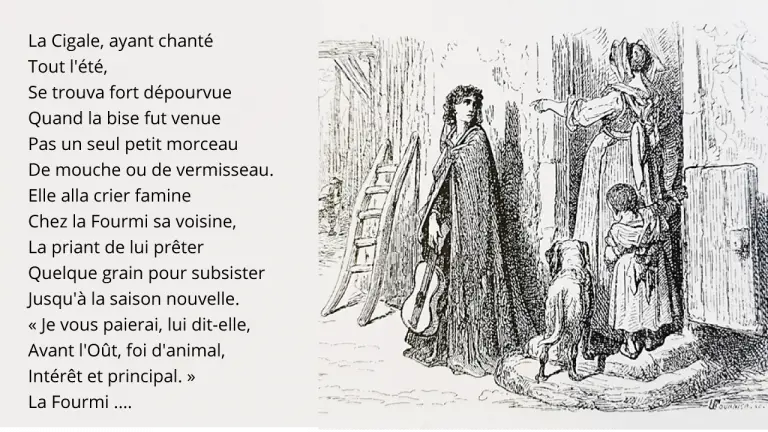
During the summer months, an ant begins to make provisions for the coming winter. Meanwhile, a grasshopper, who spends its time singing, spots it and makes fun of it.
But the cold winter arrives, and the cicada finds itself without provisions, without «a single small piece of fly or worm». She then asks the ant for help.
The fable concludes with this punchline where the ant replies to the grasshopper: «You were singing I am very pleased about that: Well then! Dance now!.
How to understand this fable and its link to data?
It is first and foremost a business story. It talks about payment, loan, borrowing, new season. The 17the The 17th century sees the arrival of Colbert's mercantilism, just as the 21st does.e The century saw the arrival of a data-driven economy and distributed architectures, which disrupted the market. The ant represents the rational spirit of progress, in contrast to the baroque spirit of the cicada.
The first moral of the story then is that one must work to survive and can only rely on oneself. The ant is clearly Data-Centric and the cicada understood nothing.
The second, more subtle moral question is: should one be like the ant, prudent and thrifty, but at the same time selfish and cold? Or should one be like the idle grasshopper, generous with its song that benefits everyone, and at ease with change?
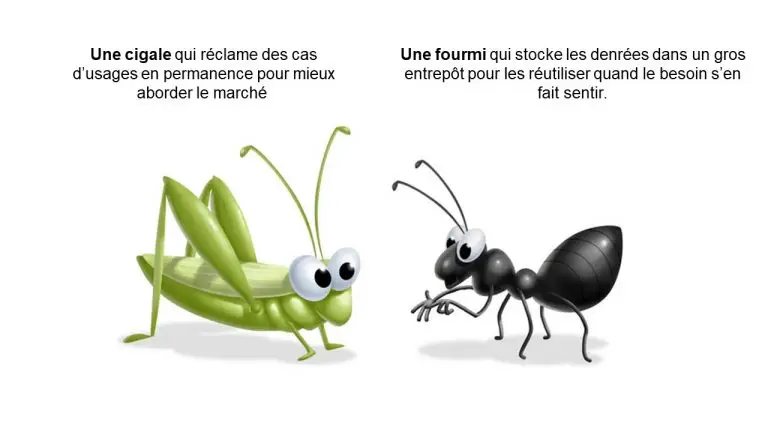
- The ant is the stereotype of planning, foresight, thrift, and storage. She hoards provisions, storing them in a large warehouse to reuse when the need arises. Therefore, the ant can be compared to datalake-type IT architectures, where all data is poured into a repository without distinction of type, and where specific business rules are created based on a client's request. For each business request concerning the data, its specific rule is created. This is the «Data Driven» architecture.
- On the other side, the grasshopper, carefree, distributes her art to everyone «Night and day I sang» seek some grain to last until the new season. A cicada so confident that she already knows she will repeat the same scenario next year. The cicada is like business demands, constantly clamouring for use cases. to better approach the market: 360° customer view, yield prediction, improved stock management, better marketing targeting, etc... She wants quick use cases. She is also «Data Driven».
So, do we have to be a Grasshopper or an Ant?
However, these two visions are incompatible. We cannot simultaneously deliver use cases quickly and avoid incurring technical debt. Our conviction at JEMS, perhaps akin to Jean de La Fontaine's fable, is that we must be both. We must be generous and a pleasure-seeker like the cicada, but also prudent and thrifty like the ant.
In any data strategy, it must be possible to:
- Use data to drive the business, be Data Driven
- Placing data at the heart of the company to generate use cases rapidly and without creating technical debt.only the Data Centric model allows us to do this.