From the Second World War onwards, researchers began to study the following question:
«How to develop our creative capacities to improve production?.
Since then, methodologies like Design Thinking have been able to materialise the answer to this question. Design Thinking is a human-centered approach to innovation that draws on the designer's toolkit to integrate people's needs, the possibilities of technology, and the requirements for business success.
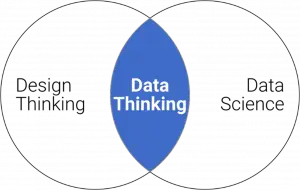
But with big data, a new way of doing things was needed. At JEMS, we call it Data Thinking.
The historical context
Our story begins in the 1940s, with war raging across Europe. In a bid to destroy the enemy, a race for science and technology is launched to find more effective strategies, communications and weapons. Sonar for submarine detection, radar for early aircraft warning, the Enigma coding of communications, the list is long.
After the war, science and technology turned towards the reconstruction of cities and infrastructure, which needed to be done quickly and better. The scene was set for research: to study the The way people think and interact in order to improve and accelerate production.
Thinking better for better creative processes and better creativity
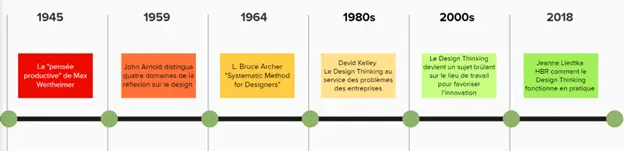
Max Wertheimer (1880-1943) in his book *Productive Thinking* (published 1945) explores what happens when people think productively. What is the process? What are the prerequisites? Is there a «right or wrong thought»? Finally: can it be improved? He thought that traditional logic stimulated thought. But that logic alone did not lead to productive thinking or new ideas. He brought the concept of insight or insight into the logic.
Arnold (1913-1963) taught creative engineering at Stanford. He wanted to understand the invention process in the scientific study of the student. Arnold broke away from the common approach of giving engineering students highly specific problems which, by definition, have only one correct answer. In practical life, design begins with studying a situation and the environment in order to define people's needs. He brought a scientific organisation to a creative process by basing the process The analysis and synthesis In 4 steps: question, observe, associate, and finally predict.
David Kelley, founder of the innovation company IDEO and Stanford University's d.school, believes that Everyone has the capacity to be creative and in his book « Unleashing the Creative Potential Within Us All«, he espouses the idea that we are all creative. In our early childhood, we revel in imaginary play, ask wacky questions, and draw blobs and call them dinosaurs. But he notices that as adults, socialisation and formal education stifle these impulses. We learn to be wary of judgment, to be more careful, more analytical. David Kelley provides conditions that encourage and boost creative confidence.
Recent examples of products and services related to Design Thinking.
Now that we know the context, what are the Things that have recently been created thanks to Design Thinking Netflix, AirBnB, the Oral B electric toothbrush, Uber Eats, PillPack, a home prescription delivery service, to name but a few. It is immediately noticeable that these innovations are all based on the data.
What is Data Thinking?
We saw the Productive Thinking and the Thinking creatively. We will also be able to include the Systems Thinking and now the Thinking with Data. The common dimension: obviously «thinking». At each era the needs of society change and personalities from different backgrounds seek solutions in the Zeitgeist (the spirit of the times); the prefixes, in a way, «productive, creative, systems»... The Zeitgeist today is «data» and at JEMS it is obvious that’It must be an integral part of the methodology that we use to bring forth solutions.
Our starting point is the same: what is the problem? Since we are «Data Thinkers», we believe that The data is also part of the problem. First, we «observe» the user and their use of the data. Then, we «associate» the different elements of the problem, the data, its impact on the user by imagining data-centric solutions. Finally, we build prototypes to get user feedback, in order to «predict» and decide whether to implement the solution, modify it or abandon the track. At JEMS, we have adapted Design Thinking and the research of Liza Kayser from the University of Twente, Roland Mueller from the Berlin School of Economics and Law, and Tizian Krosbien from Dlighted, embodied by the Data Innovation Board, to produce modular workshops to answer our clients« questions:« What are we going to do with our data? »
Conclusion
The Design thinking Is it outdated? Certainly not, as you can see, from its embryonic stages after the Second World War, it has constantly evolved and been enriched. This is the very nature of design thinking; it is iterative, evolving, and adapting to new contexts and concepts, making it a survivor of fleeting trends. The data thinking Is it the next big thing? Definitely not, it's one of the evolutions in our data world. The ingredients of design thinking are people's needs, technology's possibilities and business success requirements. As Phil Gilbert, head of design at IBM, said: «I feel that the ingredients of my gumbo are the same as everyone else's, but I insist on the ingredients of the recipe differently.».
Design thinking has always been a good idea. Discover your customers' needs and sell products that meet those needs is simply a good business idea. When you input data relating to your customers and data that could be useful to them, you get more accurate insights and more opportunities for better solutions to meet those needs.