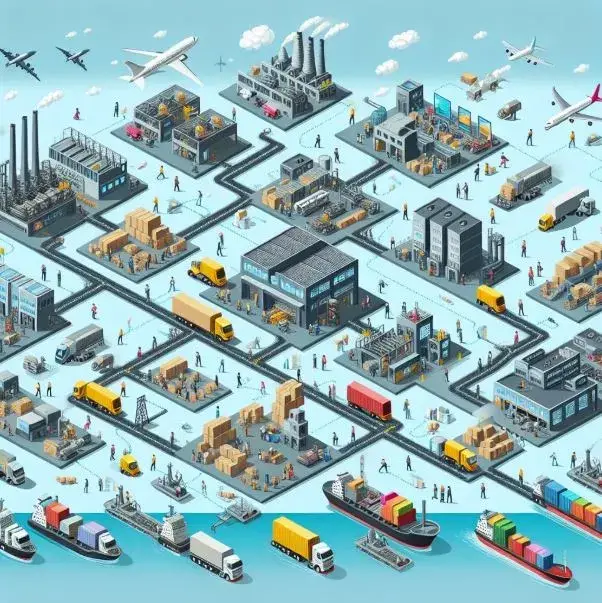
The increasing complexity of supply chains requires heightened vigilance regarding invisible dependencies and reputational risks. By combining generative AI and knowledge graphs, it becomes possible to decipher these interactions, manage risks, and ensure better control over your supplier ecosystem. Discover how this hybrid solution can transform the way you manage your supply chain.
A strong supplier dependency
In the 19th century, the transition from craftsmanship to industry meant that companies could have complete control over their production. This is no longer true today, and most use components made by others for their own production. In fact, the supply chain can quickly become very complex, involving hundreds or thousands of companies. The failure of one of them, whether economic, industrial or even ethical, can have consequences on the entire production process or even on the company's image.
It also becomes critical to be able to analyse and follow this chain. Although several companies may be listed as suppliers, they might all depend on the same upstream provider. This can give the impression of diversity in sourcing, when in reality, there is only a single main supplier. This could be described as «false multi-sourcing».
Others, anxious about their reputation, ask for ethical charters to be signed, but admit they are quite unable to monitor them. So, how do you do it when resources are limited? How to follow the news for thousands of companies? Certainly, specialist websites can help you, but you still need to take the time and effort to follow them. The question then is whether your teams have the time to follow this information or if the machine can help you with it.
It's all a matter of reading.
Information on the supply chain can come from two sources:
- Internal: these are your contracts, your references
- External: this is information communicated by third parties
The first step is therefore to compile this list of participants. Each identified supplier must be an opportunity for research to find the companies that supply them. Automated analysis of websites, thanks to AI, can make it possible to identify them. All in all, your company is the starting point and you simply have to follow the thread as far as you wish. The information collected on suppliers can / must of course go beyond their simple positioning in the manufacturing chain.
One could note for example:
- The carbon footprint of its suppliers. This is a structuring element for CSRD-type reports.
- The ability to increase or not increase production
Each piece of information extracted strengthens your understanding of the chain. Information can come from various sources, including the local press, and thus uncover scandals they may be associated with or tender notifications.
A complex problem… JEMS has the solution with hybrid AI!
With our engineering teams, we have worked on a hybrid AI, mixing generative AI with more traditional, less power-hungry AI. In order to avoid collecting irrelevant information and getting lost in the data, the question that should be asked is: “what do we really need?».
Here, the use of Generative AI is entirely relevant. It allows us to speed up the identification of company names. The expression «they trust us» allows us to identify a client-supplier relationship which would be difficult to detect with other types of techniques. The most advanced versions will even be capable of analysing images, tables or any other documentary source.
Attention, in the context of using these technologies, it is important to monitor the models, their results, and their performance. At JEMS, we are very active on this subject and it is of particular importance to us. We believe that a Machine Learning solution cannot last over time if there is no monitoring in place.
After extracting the desired data, our engineers injected it into a database specialised in object relationships. The aim of this action is to detect over-reliance on a single supplier, CSR risks, increasing competition, or financial risk.
Ultimately, the solution found allows for the transformation of unstructured, multiple and disparate information into easily actionable data for humans.
Conclusion
Mastering your supply chain is not an option. Paradoxically, diversifying it is both an asset, as it allows you to focus on your added value, but also a weakness, as dependencies become very strong. In the age of social media, the bad reputation of one link can easily contaminate the entire chain. Generative AI, with its ability to analyse and dissect various documentary sources, combined with a knowledge graph, formally representing information, can be remarkable assets for mastering it as effectively as possible.
At JEMS, we offer innovative solutions to transform this complexity into opportunity. Our technologies not only identify critical dependencies and potential risks, but also detect optimisation levers, reduce carbon footprint, and strengthen compliance with CSR regulations, such as the requirements of CSRD reporting.
By collaborating with JEMS, you gain unique expertise to industrialise these solutions and integrate them into your existing processes. We help you transform your supply chain into a true lever for resilience and innovation.
Would you like to go further? Contact our experts to discover how our bespoke solutions can meet your specific challenges. Let's build a more agile, transparent, and efficient supply chain together.