This summer, France will be under the world's watchful eye for the XXXIII Olympic Games.ème Olympics and the XVIIème Summer Paralympic Games. During this period, many athletes will travel across the globe to participate in the greatest sporting competition there is. Even if we primarily think of the athletes, they are not the only ones who will allow us to feel the excitement. Volunteers, spectators, all will have a role to play, including officials, such as referees, judges, observers, and technical officials. It is within this last category that my role lies for this event.
Turning a passion into a goal
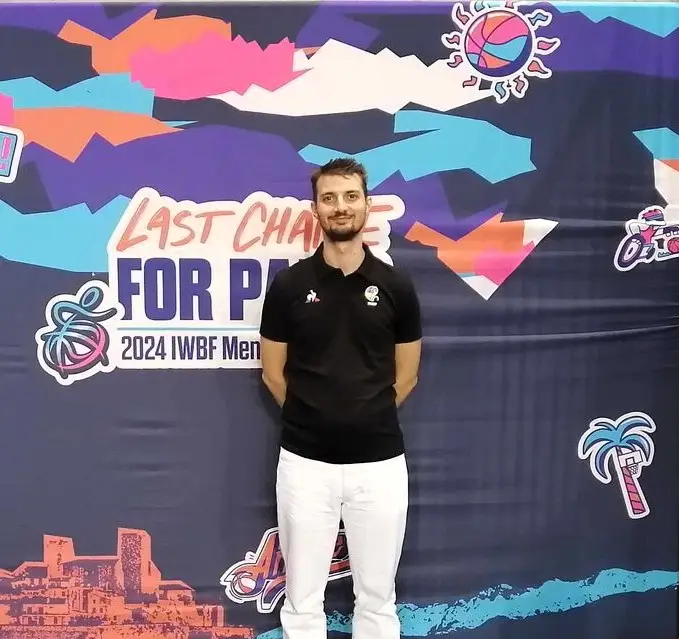
Let's put a bit of context back in: I'm Mathieu GAULTIER, I'm 29 years old, I'm Data consultant at JEMS and during August and September, I will be in Paris as the NTO (National Technical Officer) for the Paris 2024 Paralympic Games.
It all started many years ago when I was playing and coaching at my basketball club. I would always ask myself the question, «How can I improve my game or the team's performance?»Upon researching, I discovered the world of statistics and tailored my university studies around this subject, completing a DUT in Statistics and Decision-Making Informatics (now BUT SD) and a Master's in Computer Science and Statistics to gain data analysis methodologies, as well as the ability to translate data into relevant and understandable elements.
Alongside my studies, I continued to research the use of data in the world of sport, both in France and abroad. It was ten years ago, after a France international match which I attended as a spectator, that I decided to go speak to the manager of the statistics department competitions at the French Basketball Federation (FFBB). Over time and after further discussions, he informed me that the ASVEL Féminin club was looking for a statistician to enter match actions in real-time and that he could put me in touch with the management. An opportunity I didn't miss! I was thus able to discuss with the club and take my place at the scorer's table as a statistician for the professional women's basketball team in Lyon in 2014.
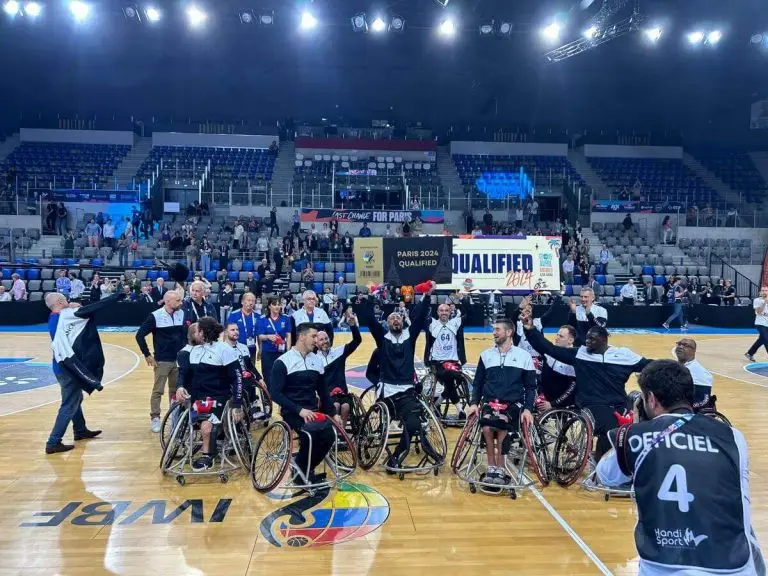
Over time, new opportunities allow me to broadcast matches of ASVEL Féminin in addition to international matches, both for the French team and other world nations during tournaments, championships or other preparation matches. Notably with highlights such as: the Women's European Championship in 2021 in Strasbourg, the double European Championship/Cup with the club in 2023 and mainhosting the Paralympic Games, not to mention the preparation during the TQP (Tournament of Paralympic Qualifier) in Antibes a few weeks ago.
Transcribe the terrain into statistical data
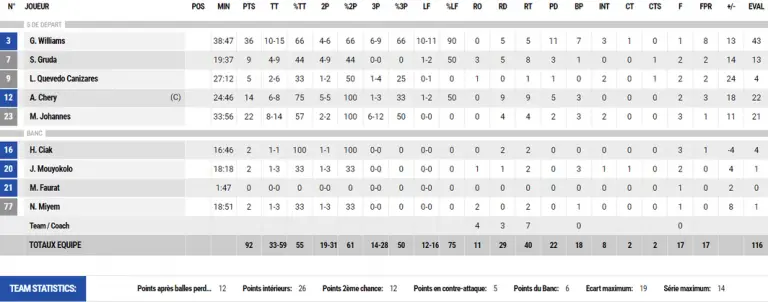
I'm often asked, I'm transcribing what's happening on the ground in real-time on software. To have a list of all the actions taking place. Like a recipe, each action must take place to move on to the next: for example, a shot must be followed by the information «scored or missed» and if it is scored, is it via an assist.
If this seems complex to do, our methodology is as follows: we work in pairs, a "shouter" (the person announcing all the match actions) and a "clicker" (who enters these actions). While some may specialise, within the club, we have dual skills which facilitates communication between us, but also allows us to state the actions in the order they are entered into the statistics collection tool.
So that the data entered in France is consistent, Training courses are held every year To clarify the rules and define each of the terms referenced in the software. If a meeting takes place annually for the national championships, for the international part, the process is a bit more complex. Indeed, a minimum of two years' seniority must be proven and an apprenticeship course with the International Basketball Federation (FIBA) must also be followed in order to obtain a diploma valid for two years. At each stage, training on statistical recording methods during matches must be followed in order to then pass a multiple-choice test in English with a minimum score of 75%.
A more diverse use
Observation skills, communication, but above all, rigour are essential skills. Indeed, match statistics are useful for coaches and team staff for performance analysis, but also for player agents to help demonstrate a person's contribution to a team.
Another important aspect is the real-time availability of data on online score-tracking platforms, which allows internet users or app users to follow the course of the match. A final, significant impact regarding the need for rigour is the link between sports betting sites and the data collected, since when a bet is placed on a victory of 10 points or more, the difference in score will be calculated based on the scores in the software. In the event of an error, this can therefore lead to significant economic repercussions.
To conclude, the opportunity to participate as an official in a major event like the Paris 2024 Paralympic Games is the The realisation of a dream and the continuation of a journey for which I have worked in recent years. Through these experiences, I have discovered the importance of data in sport, for athletes and teams, as well as for fans and organisations. I will be able to represent the Paralympic values that are dear to me and I am eager to experience the emotions of such a competition.