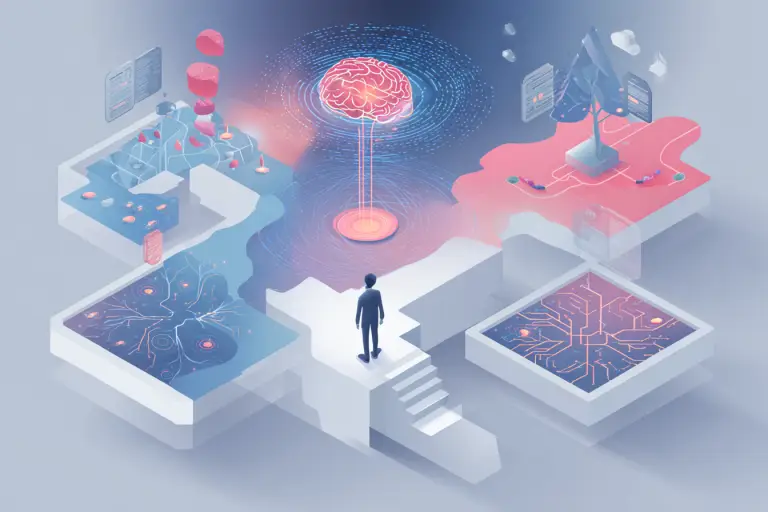
AI agents are transforming data analysis into intelligent, proactive, and autonomous decision-making assistants, capable not only of reporting on the past but, crucially, of anticipating needs, recommending, and executing actions in real-time.
For years, dashboards have embodied the promise of rational and informed management. Each department (HR, marketing, finance) has built its own indicators, charts, and KPIs. But these tools, however powerful, are based on a static logic: that of data which must be analysed, interpreted, and commented on manually.
However, in a world where information travels at the speed of milliseconds and organisations must continuously adjust their decisions, this approach reaches its limits. Intelligent decision support systems herald a new era: one of proactive interaction with data, where AI no longer just observes the past, but anticipates, recommends, and acts.
Why aren't dashboards enough?
A classic dashboard offers a snapshot of the past. It answers the question: What happened?
But in practice, trades must offer far more than that: What will happen? Why is this trend evolving? What action should I take now?
Or, obtaining these answers requires time, manual correlation between different reports, and often advanced analytical skills.
Unlike traditional dashboards, these assistants are based on the principle of continuous dialogue with data. They automatically monitor key indicators, detect anomalies, explain probable causes, and suggest action plans adapted to the context. The user asks a question in natural language; the assistant detects the need, compiles the information, and generates a contextualised answer, sometimes even before being prompted.
The analysis is no longer being done in hindsight it becomes conversational, instant and result-oriented.
From analysis to action: how do these new assistants work?
Intelligent decision support systems are based on a simple principle: transforming data into dialogue. The user no longer searches, they ask. And the assistant doesn't show, it answers, sometimes even before the question is asked.
The essential bricks
| Functionality |
Business benefit |
| Natural language interaction |
Users can query their assistant (“What are the performance gaps by region?”) without technical training. |
| Proactive surveillance |
The assistant sends alerts 24 to 48 hours before an incident impacts performance. |
| Share recommendations |
It automatically generates decision scenarios or “playbooks”, reducing decision cycles by 60%. |
| Autonomous execution |
Certain processes are automated (client reminders, budget adjustments, HR alerts), freeing up to 70% of analytical time. |
| Continuous learning |
The system learns from business feedback and refines its recommendations over time. |
This shift from consultation to collaboration profoundly changes how business functions leverage data.
AI is becoming an everyday teammate, capable of helping, advising, and sometimes acting.
Sector-specific use cases
In banking and finance, the assistant detects suspicious transactional patterns in real time, automatically blocks risky operations, and alerts the compliance department. It also proposes personalised portfolio allocations according to market news, client objectives, and regulatory constraints.
In e-commerce and retail, the agent dynamically adjusts prices and offers based on purchasing behaviour, competition and stock levels, which can increase revenue by more than 10%during peak demand. It anticipates stockouts and automatically triggers replenishment, reducing stockouts by up to 35%.
In Industry 4.0, predictive maintenance combines IoT data, failure history, and predictive models to automatically schedule interventions before incidents occur, minimising production downtime. The energy optimizer adjusts line consumption in real-time according to electricity costs and workload.
What they are changing for support functions
Decision support assistants don't just benefit data teams and IT departments: marketing, HR, finance, and operations can now act faster and with greater precision.
In human resources, the assistant anticipates absenteeism spikes, detects early warning signs of disengagement, and automates monthly reporting with proposals for improving quality of working life.
In marketing, it adjusts budgets between channels based on real-time performance and suggests optimisations as soon as a campaign underperforms.
In finance, he spots accounting anomalies before closing, projects cash flows and recommends corrective actions on budget forecasts.
Before / After: a change of posture
| Avant (classic dashboard) | After (Intelligent Decision Support) |
|---|
| The user is checking their KPIs to understand a trend. | The assistant warns the user of a change and explains its causes. |
| Manual data analysis and report writing. | Automated synthesis and ready-to-validate recommendations. |
| Retrospective: “what happened”. | Proactive vision: “what will happen and how to react”. |
| Decisions made after several meetings. | Faster decisions through contextualisation and partial execution. |
This shift from consultation to collaboration profoundly changes how business functions leverage data.
AI is becoming an everyday teammate, capable of helping, advising, and sometimes acting.
Implement an intelligent decision support system
Moving from the dashboard to the assistant requires a progressive, structured approach tailored to each organisation's data maturity.
Here are the main steps for a successful deployment:
- Diagnostic
- Identify priority use cases: HR reporting, performance, budget forecasting, etc.
- Assess the quality and availability of existing data.
- Prototype (MVP)
- Design a first assistant focused on a critical indicator.
- Measure time savings and recommendation quality.
- Extension
- Extend to other departments.
- Integrate continuous learning and user feedback.
- Industrialisation
- Automating the deployment, monitoring, and governance of AI models.
- Ensure security, transparency, and compliance (GDPR, explainability, ethics).
The keys to success: governance, training, adoption
Success does not depend solely on technology. Three levers are essential: data quality, trust in recommendations (through transparency and explainability), and change management to train employees in a new way of interacting with data.
JEMS intervenes across these three dimensions, from structuring data heritage to creating personalised AI assistants, designed to enhance business decision-making.
Towards human-AI collaboration for the benefit of professions
Intelligent decision support systems mark the end of the era of passive reporting. They establish a new relationship with data: conversational, dynamic, and results-oriented.
Businesses that take this step will no longer just measure their performance; they will drive it continuously, with unprecedented agility and precision.
Thanks to partners such as JEMS, they can transform their data into a truly living ecosystem, capable of anticipating, acting and improving day by day.
Fancy going further with intelligent decision support assistants?