When enthusiasm meets reality
Artificial intelligence is everywhere. In discussions, strategies, management committees. For months, it has become a top priority for many companies, across all sectors. Automate, predict, accelerate, personalise: the promises are numerous, sometimes spectacular. Too many, perhaps.
But behind the initial enthusiasm, a reality is gradually asserting itself: many initiatives struggle to move beyond the demonstration stage. Business departments see attractive prototypes, but concrete results are slow to materialise. Projects follow one another, expectations rise, and the question becomes unavoidable: Where is the value?
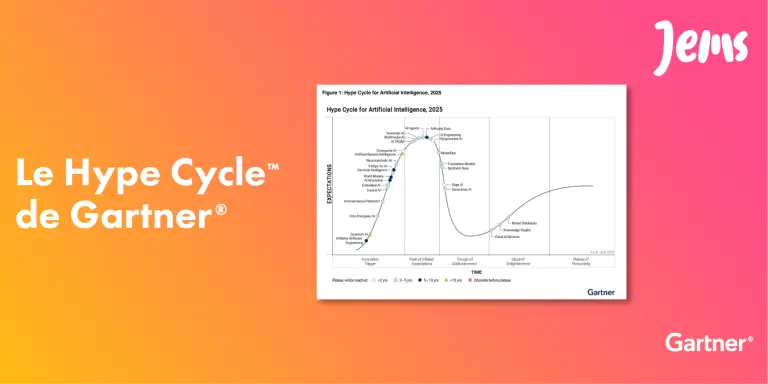
This discrepancy is nothing exceptional. It is even perfectly documented. Our view is that for years, the Hype Cycle™ Gartner®, describes this recurring mechanism in the adoption of technological innovations. AI is no exception.
Today, we are witnessing a pivotal moment. A moment where the market is starting to sort out what impresses... and what truly transforms organisations. For business decision-makers, the challenge is no longer to «test AI,» but to to know how to make it a sustainable lever of performance.
Our understanding of Gartner's® Hype Cycle of AI: a repeating pattern
From our point of view, the Hype Cycle™ Gartner® It describes a simple, yet powerful trajectory. When an innovation emerges, it first sparks great euphoria. Use cases multiply, promises escalate, and investments follow. Everything seems possible.
Then comes the confrontation with reality. Operational constraints emerge: incomplete data, complex integration, underestimated costs, limited adoption by teams. The advertised value isn't always delivered. This is the disillusionment phase.
Finally, for organisations that persevere and structure their approach, a phase of maturity sets in. Technology is better understood, better governed, better integrated. It ceases to be an object of fascination and becomes a useful, reliable, and controlled tool.
What is the current state of the AI market?
On AI, the market is located at the top of the curve, with the first signs of a U-turn. Many actors know how to provide a convincing demonstration. Far fewer know how to build a system capable of functioning over time.
In businesses, this observation is increasingly shared:
- Proof of concepts are multiplying, but few make it to production.
- The results are difficult to measure.
- Business teams remain cautious, sometimes sceptical.
This is not an AI failure. It is the normal transition between promise and actual use.
Download the full report on the Hype Cycle™ Gartner® AI to understand market dynamics and AI technology maturity trajectories:
From a technological showcase to an industrial asset
A useful AI is not a showpiece. It's not an impressive tool in a meeting. It's not a standalone prototype.
A useful AI is an industrial asset.
This means that it must meet the same requirements as any other critical system within the company.
- to be reliable, day after day,
- to be governed, with clear rules,
- to be auditable, to understand and explain its decisions,
- to be master's degree in costs,
- to be sustainable in the long term,
- and above all, to be adopted by the trades, as it meets a real need.
Let's take a concrete example: a finance department might have a very advanced predictive model on paper. If it relies on unstable data, if it requires constant adjustments, or if it isn't understood by the teams, it will quickly be abandoned. Conversely, a simpler but robust model, integrated into existing processes, will create a measurable impact.
It is often at this stage that the gap between the hype and the value widens.
How to approach AI after the hype? A pragmatic approach
Moving from promise to performance requires a change in posture. It’s no longer about asking «what can AI do?», but «How can AI be permanently integrated into our operations?»
A few principles make the difference, whatever the sector or trade concerned:
- Starting from business uses, no technology
An effective AI answers a precise problem: reducing a delay, improving a decision, securing a process.
- To rely on reliable and understood data
Without quality data, AI remains a promise. Structuring data heritage is a prerequisite, not an option.
- Integrate AI into existing processes
An isolated tool is rarely adopted. AI needs to be integrated into everyday tools and practices.
- To think about exploitation right from the start
Performance monitoring, incident management, model evolution: AI is alive and evolving.
| Proof of Concept AI (hype logic) | Industrialised AI (value logic) |
|---|
| Spot demonstration | Integrated system within the company's operations |
| Objective: to prove that “it works” | Objective: Create measurable business impact |
| Partial or poorly governed data | Structured, reliable and controlled data |
| Little or no integration with the IS | Full integration with existing tools and processes |
| Costs and efforts underestimated | Costs controlled and managed over time |
| Low adoption by business users | Real adoption by operational teams |
| Difficult to maintain in the long term | Exploitable, maintainable, and scalable |
| Difficult to measure value | Tracked and substantiated value |
At JEMS, we are building the second wave of AI.
Many initiatives fail not because of the model, but due to a lack of anticipation: data evolution, organisational changes, new uses. A useful AI is an AI designed to last.
At JEMS, we've observed this cycle repeatedly. With Big Data. With the cloud. Each time, the same pattern: a highly visible first wave, then a second, more discreet but decisive one.
Our conviction is simple: It's not those who make the most noise who create lasting value..
We are deliberately positioning ourselves at this tipping point in the Hype Cycle. Where we stop doing AI for AI's sake. Where we start building truly actionable systems.
Concretely, this means taking into account the Real limits of technology and to pose, from the design stage, what hype often avoids:
- data quality and understanding,
- governance and clear responsibilities,
- integration into the information system,
- ability to track, maintain and evolve solutions,
- Objective measurement of business impact.
This approach isn’t spectacular. It’s demanding. But it’s what allows AI to become a Operational performance lever, and not a passing fad.
After the hype, the value
We think that the Hype Cycle™ AI should not be seen as a warning, but as an opportunity. The opportunity to move beyond the noise, make clear-headed choices, and build truly meaningful applications.
For business decision-makers, timing is crucial. Those who can go beyond the promise to structure reliable systems will gain a head start. The others risk being disillusioned.
At JEMS, we help organisations make this transition: transforming AI from a spectacular promise into an industrial asset, creator of measurable, reproducible and sustainable value. Not by following the hype, but by building, step-by-step, the second wave of useful AI.
Are you questioning the real maturity of your AI initiatives or their scaling? Our experts can help you evaluate your use cases and structure truly useful AI for your business.
Gartner, Hype Cycle for Generative AI, 2025, By Arun Chandrasekaran, Leinar Ramos, 14 July 2025
Gartner and Hype Cycle are registered trademarks of Gartner, Inc. and/or its affiliates. Gartner does not endorse any company, vendor, product or service depicted in its publications, and does not advise technology users to select only those vendors with the highest ratings or other designation. Gartner publications consist of the opinions of Gartner’s business and technology insights organisation and should not be construed as statements of fact. Gartner disclaims all warranties, expressed or implied, with respect to this publication, including any warranties of merchantability or fitness for a particular purpose. This graphic was published by Gartner, Inc. as part of a larger research document and should be evaluated in the context of the entire document. The Gartner document is available upon request from JEMS.