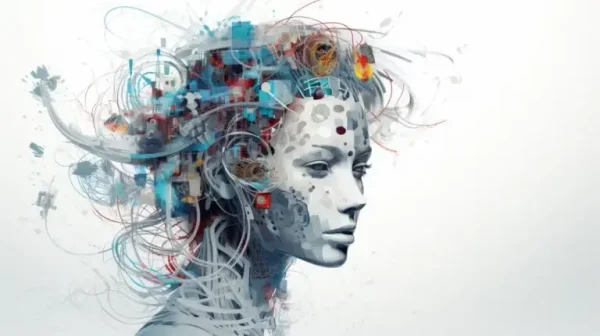
« l’IA générative et ses possibilités ». (1/5). Et c’est reparti. Depuis la dernière version de ChatGPT en mars 2023, on se remet à craindre l’IA. « IA générative facteur de risque », « Gen IA et la fin des RH », « la K-pop bouleversée par l’IA générative », « 82% des entreprises vont interdire ChatGPT ». Pourquoi l’IA générative (re)fait peur ? Finalement c’est un peu comme utiliser un moteur de recherche, non? Premier article d’une série pour essayer d’y voir plus clair avec l’IA générative.
Generative AI - is that the same thing as Google, basically?
What is generative AI? According to ChatGPT, generative AI is a A model capable of creating original content, such as text, images, videos, or sounds, by mimicking patterns and characteristics present in the training data.. Generative AI techniques are based on learning algorithms called one-shot and zero-shot. Learning occurs with limited amounts of data (in the case of one-shot) or it allows for the recognition of certain classes without ever having been trained for it (in the case of zero-shot). See this article.
Therefore, it can be used professionally for generating predictive videos, modelling 3D shapes in architecture, generating voices from text (La Matinale Le Monde), creating musical groups (Eternity), etc. And among the best-known tools, we will find ChatGPT (OpenAI) but also AlphaCode (Deepmind), GiHub Copilot (GitHub & OpenAI), Bard (Google), Jasper (Open source), DALL-E, copy.ai, etc…
In the case of ChatGPT, how is it different from a search engine? One will give answers in natural language, the other will return images or videos with sources. One is based only on data uploaded online before September 2021, the other indexes the entire web «up to date». In both cases, the notion of cognitive biases is important.. Here are the subjective differences with a comparison to the human being:
Search engine (e.g. Google)
Chatbot (ChatGPT)
The human being Me
How to perform a search?
By a sequence of keywords
In natural language
You must ask me politely
Type of response given
Metadata: images, sounds, texts, videos
A text in natural language where the sources are not specified.
Subjective with 250 possible cognitive biases
Advertising
Yes
No
–
Database
Real-time web indexing
Data up to September 2021
What my little brain can hold
Ethics?
A recurring problem
Restrictions on usage that vary depending on the AI
It depends on the eras and cultures
A human representation of generative AI that remains too systematic. Midjourney
Why are we only talking about it now?
Generative AI has been around since the 1960s. So it's about 63 years old, the same age as Yannick Noah. So it's nothing new. In 2014, the arrival of new architecturesSay GAN (Generative Adversarial Network – Generative Adversarial Network) significantly accelerates developments in generative AI. GANs use a technique Machine Learning which pits two neural networks against each other, one that creates (the generator) and the other that detects the generated data amongst the original data (the discriminator), so that the generator can win out, over successive cycles, against the discriminator.
Then in November 2022 other models emerged, such as the Transformers and VAE (Variational Autoencoders) and OpenAI's initiative that will popularise these tools for the general public with the release of ChatGPT version 3.5.
Will humans be replaced?
Humans are complex. They use a wide variety of thought patterns to understand, analyse and solve problems: deduction, induction, analogy, probabilistic reasoning, reasoning by contradiction, or critical thinking.
Artificial intelligence programmes are surpassing us in the deduction (the ability to infer a conclusion from general propositions), induction (generalisation from specific examples: I saw several black crows in the trees, therefore all crows are black) or probabilistic reasoning (the basis of ChatGPT).
Human beings, in their choice of decisions, are influenced by their life experiences, emotions, and conscience. A conversational agent has no deep understanding of things. It is software. In the 1920s, these objects were dubbed «Artificial Intelligence.» This was probably a great misstep. It would have been more accurate to call them «Data Science» or «artificial agent,» for example. We have observed excesses in its use in cinema or literature, contributing to a surge in certain unfounded fantasies.
If all the major platforms have their generative AI, Bard (Google), Ernie (Baidu), Llama2 (Meta), nobody knows how generative AI will evolve. To go so far as to favour proponents of outrageously strong AI, I think we're going too far.
An abstract representation of generative AI. Midjourney
What's next for generative AI?
In our upcoming articles, we will explain the benefits for the company in more detail: how it will be able to inject its own data to generate use cases, the importance of training data sets, and the need for IT departments to renew their infrastructure.
To provide the best experiences, we use technologies such as cookies to store and/or access device information. Consenting to these technologies will allow us to process data such as browsing behaviour or unique IDs on this site. Not consenting or withdrawing consent may adversely affect certain features and functions.
Functional
Always active
Technical access or storage is strictly necessary for the legitimate interest of enabling the use of a specific service explicitly requested by the subscriber or user, or for the sole purpose of carrying out the transmission of a communication over an electronic communications network.
Preferences
Technical access or storage is necessary for the purpose of legitimate interest in storing preferences not requested by the subscriber or user.
Statistics
Storage or technical access that is used exclusively for statistical purposes.Technical storage or access used exclusively for anonymous statistical purposes. Without a subpoena, a voluntary compliance from your Internet Service Provider, or additional records from a third party, the information stored or accessed for these sole purposes generally cannot be used to identify you.
Marketing
Technical access or storage is required to create user profiles for advertising, or to track the user on a website or across multiple websites for similar marketing purposes.