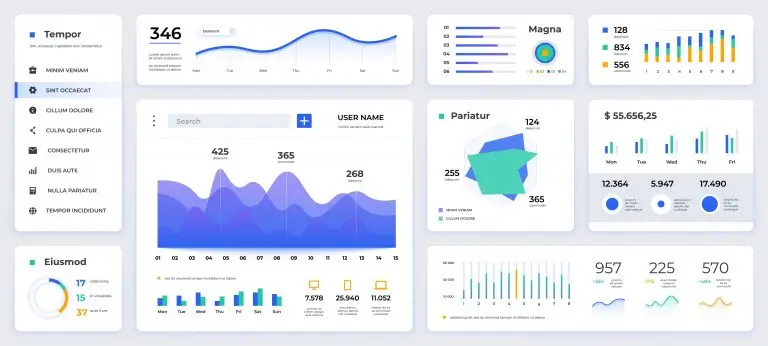
A dashboard is a control and management tool for a digital service which, with the help of a set of KPIs and data, allows for the monitoring of an activity and its real-time evolution. Today, thanks to our expertise in component systems design, we can support their creations and maintenance.
Indeed, to effectively design products that require the integration of a data visualisation platform, we leverage design systems in conjunction with DiXit's offering to meet the reliability and agility constraints inherent in your needs. We will attempt to explain the reasons for this here.
Dashboard design all too often runs into the principle of reality
Numerous data visualisation tools exist, but few allow you to account for the actual use of your data at the prototyping stage. This decoupling often leads to a gap between UX, UI, integration, and the final product. A design system addresses this problem by integrating a library of charts that are both responsive and adapted to all types of data exploitation. Thanks to it, you will no longer have any surprises when your dashboarding solution goes into production, and you will be able to simplify the workflow of the design team associated with the project.
Services like Power BI or Tocan Toco have understood this well. Thanks to NoCode logic and an embedded library of charts, they allow for very rapid prototyping and development based on a pool of real data. In doing so, they meet the primary needs of clients and users, achieve strong growth in the Business Analytics market, and ensure their longevity.
The design system as an aid for dashboard design
Thanks to the guidelines and templates of a design system, you'll be able to detach yourself from this issue to focus solely on UX and the implementation of your solutions.
The style guide of a design system will also help you choose the right colours to associate with your data, thus avoiding the pitfall of unreadable charts. You will then bring visual consistency and reduce the mental load of your users when they analyse and decode the available information.
Finally, a design system will give you all the elements to guarantee accessibility for all types of users of your solutions. Among the elements, you can find: responsive management, WCAG standards, Dark/Light mode, ...
Google and London City Intelligence have already integrated these key pieces of information into their design system's style guide to industrialise their processes and guarantee the quality of their products, so why not you?