Companies have structured their data. They must now make their knowledge actionable.
For several years, organisations have been investing heavily in data governance. Data catalogues, business glossaries, quality policies, lineage, regulatory compliance, or AI governance: companies have gradually understood that data must be considered a strategic asset. This transformation was necessary.
Without governance, the use of data and AI remains difficult to industrialise. Indicators become inconsistent, projects multiply without a common framework, and departments lose confidence in the data they use. But a new limitation is emerging today.
Even when data is governed, employees still struggle to genuinely access useful knowledge. Understanding a metric, finding a business rule, explaining a calculation, or contextualising information often remains complex.
In many companies, this knowledge already exists. It is simply scattered across documents, business tools, procedures, human interactions, or rarely formalised operational habits. This change is largely accelerated by the advent of generative AI usage.
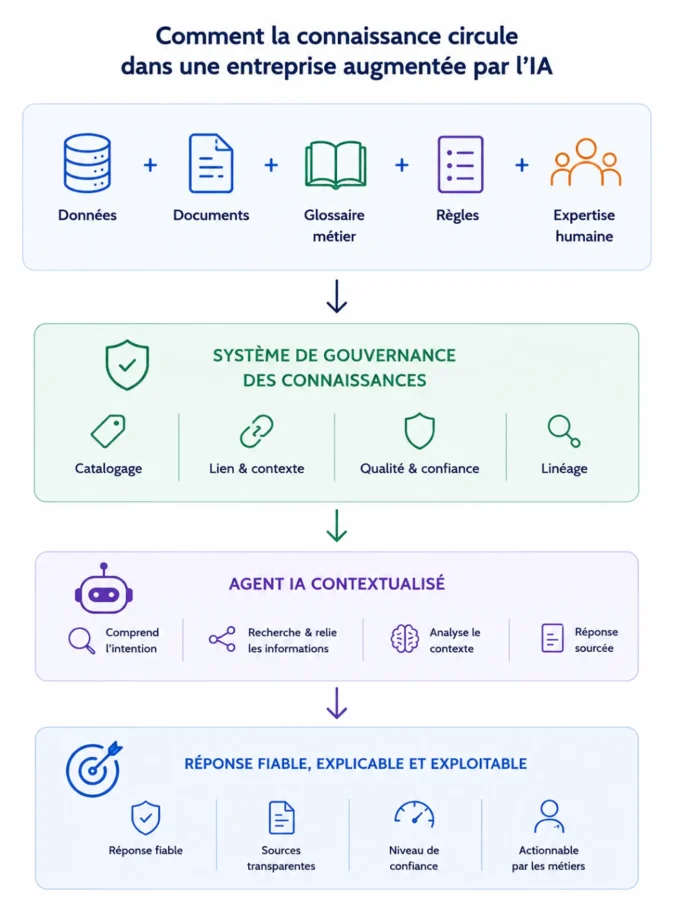
Because an AI doesn't just feed on data. It also relies on documents, rules, business definitions, histories, processes, and operational contexts.
The challenge then becomes much broader than simple data governance. It is now about governing business knowledge itself. And this evolution could profoundly transform the way organisations design their information systems, their AI uses and their ability to transmit their business know-how.
Why data governance is no longer enough
For a long time, data governance primarily served three objectives: making data reliable, improving compliance, and standardising its use. This approach remains indispensable. However, it is reaching its limits today in the face of new AI uses.
Because an AI model doesn't naturally understand a company's business context.
A financial indicator, an HR procedure, a compliance rule or technical documentation only has value if it is linked to its definition, its use, its history and its level of trust. However, in many organisations, this knowledge remains largely fragmented.
The data exists on analytical platforms. The business rules are in documents. The decisions are made through human interactions. The processes are in different tools. And the real understanding often remains with a few experts.
This fragmentation creates several major difficulties: high search times, strong dependence on experts, low reuse of information, and unreliable AI responses.
The current limitations of governance systems
AI is transforming the relationship with business knowledge
|
Observed limit
|
Business impact
|
|
Data disconnected from the business context
|
Difficulty in interpreting the results
|
|
Scattered documentation
|
Long search time
|
|
Expert knowledge
|
Organisational dependence
|
|
Lack of links between data and usage
|
Low reuse
|
|
AI without business context
|
Unreliable answers
|
The problem becomes even more apparent with AI agents. a conversational agent capable of querying data without business understanding can produce quick, but incorrect or incomplete answers.
Conversely, AI capable of linking data, documents, business glossaries, lineage and operational context can act as a real catalyst for decision-making and productivity. It is precisely this that is giving rise to a new strategic focus: knowledge governance.
Knowledge governance transforms the role of information systems
Knowledge governance is not simply about storing more documents or improving document search. It's about making informational assets actionable by both humans and AI systems. This shift profoundly transforms the role of data and document platforms.
For a long time, information systems were primarily designed to store, organise, secure and distribute information. In the future, they will also need to understand context, link knowledge, explain decisions and provide actionable answers in natural language. In other words, businesses are gradually shifting from a focus on storage to a focus on knowledge activation.
This development is based on a significant transformation: automatically linking data, business definitions, associated documents, management rules and operational practices in order to contextualise the information. The aim is no longer simply to retrieve a document or a piece of data. It is now possible to understand why a piece of information exists, how it is used and what level of trust should be placed in it. This aspect is becoming essential for ensuring the reliability of AI applications.
Another significant development concerns tacit knowledge. Much of a company’s value still rests on non-formalised knowledge: human expertise, historical trade-offs, lessons learnt, and business exceptions.
When this knowledge remains tacit, the company becomes dependent on certain key individuals. Projects slow down, decisions become harder to justify, and the transfer of knowledge becomes fragile. AI agents offer a new opportunity here: to gradually transform this dispersed knowledge into an asset that can be utilised on a large scale.
The issue of trust is also becoming a key concern. AI that is capable of responding quickly but lacks transparency can pose significant risks in terms of compliance, decision-making quality and the dissemination of incorrect information.
Companies will therefore need to be able to explain the sources used, the context, the level of confidence and the lineage associated with each response. Knowledge governance thus becomes a central aspect of AI governance.
How can businesses begin this transformation?
The most forward-thinking organisations now view knowledge governance as a cross-functional area that combines data, documentation, AI, governance and business transformation. This shift does not necessarily require replacing existing tools; rather, it involves creating intelligent links between the systems already in place within the organisation.
The first effective steps often involve identifying critical knowledge, linking data and business definitions, structuring key rules and documents, and facilitating conversational access to this knowledge. The objective is not solely technological. It is primarily about reducing the “cognitive cost” of accessing information.
For in many companies, the main obstacle is no longer a lack of data. It is the difficulty in quickly understanding what the data means and how to use it correctly. Companies that successfully achieve this transformation will enjoy a significant advantage: faster decision-making, greater autonomy for business units, reduced research time, more effective knowledge transfer, and more reliable standardisation of AI applications.
The next AI battle will be fought over business knowledge
The market talks a lot about AI models, autonomous agents, or technological performance. But the real differentiator in the coming years will probably lie elsewhere.
The companies that will truly derive value from AI will not necessarily be those with the most powerful models. They will be those capable of making their knowledge base usable, contextualised and properly managed. This development marks a significant shift.
For a long time, data was the main strategic asset. Tomorrow, it will probably be the ability to connect data, context, business expertise, documentation, and operational reasoning. In other words, value will no longer come solely from the data itself, but from the ability to transform that data into actionable knowledge for AI and usable by the business.
Organisations that successfully navigate this transition will enjoy a significant advantage: greater team autonomy, faster decision-making, better capitalisation on knowledge, reduced reliance on experts, and a much more reliable scaling of AI applications.
Ultimately, the distinction between search engines, data catalogues, document databases and AI assistants will gradually disappear. The most mature organisations will no longer build separate tools, but rather fully-fledged knowledge systems capable of understanding the business context, coordinating multiple sources and delivering information that can be put to immediate use.
This evolution marks probably one of the most significant transformations in the use of data and AI in business.
Towards AI that is truly useful for trades
Generative AI is profoundly transforming user expectations. Employees no longer just want to access data or documents. They want to understand, question, and simply leverage the company's knowledge.
This trend is prompting organisations to move beyond simple data governance and build systems capable of contextualising and leveraging their information assets on a large scale.
At JEMS, we support companies in this transformation by designing systems capable of connecting governance, data, documents, lineage and AI use cases to make knowledge truly exploitable by business functions.
To find out more, also discover the JEMS IA DataKnowledge approach, developed around the intelligent exploitation of company knowledge: