Artificial intelligence is already transforming French businesses, with automated risk analysis, personalised customer relations and optimised business processes. The AI market in France is growing by almost1A 29% a year and is expected to reach €20 billion by 2030.
Yet a paradox persists: the rise of generative and agentic AI has revolutionised digital transformation, but many organisations are still stuck between experimentation and large-scale production. The key strategic question remains unanswered: where is my data hosted? Who has access to it? What infrastructures do my models run on?
Sovereign AI is emerging as a priority competitive challenge for all business departments. With the AI Act regulation and the €109bn of investment in AI infrastructure in France, the question is clear: «how do we get involved in concrete terms?»
An alliance to structure and enhance data
In an environment where data is multiplying, structuring it is an essential step to get the most out of it. This is the foundation of the partnership between JEMS, an expert in data lifecycle management, and Snowflake, a specialist in cloud platforms. Together, these two players design robust and scalable solutions, tailored to the needs of businesses.
Implementing a robust infrastructure not only organises data but also ensures it is accessible and usable at scale. This framework is essential for effectively integrating technologies like generative AI, which require large volumes of well-structured data to deploy their full potential.
As Patrick Chable points out: « A solid and well-structured foundation is essential to get the most out of AI. That's why our collaboration with Snowflake is at the core of large-scale projects. Together, we are building robust solutions that enable the industrialised integration of AI. »
Demystifying Generative AI: Beyond the Buzz, Real-World Cases
Generative AI, although often associated with anecdotal use cases, offers real strategic opportunities when used thoughtfully. However, its integration requires a rigorous and structured methodology. This involves asking key questions before embarking on it:
- Les processus où l’IA générative peut apporter une réelle valeur ajoutée sont nombreux et couvrent divers secteurs. Voici quelques exemples clés :
**Création de Contenu :**
* **Rédaction :** Génération d'articles de blog, de descriptions de produits, de messages sur les réseaux sociaux, de scripts, de poèmes, de courriels personnalisés et même de code informatique.
* **Image et Vidéo :** Création d'illustrations, de logos, de photographies, de vidéos promotionnelles, d'animations et d'effets spéciaux.
* **Musique et Audio :** Composition de musiques originales, création de voix off, de podcasts et d'effets sonores.
**Design et Prototypage :**
* **Conception de Produits :** Génération de concepts de produits, de maquettes et de prototypes, accélérant ainsi les cycles d'innovation.
* **Design d'Interfaces Utilisateur (UI) et d'Expérience Utilisateur (UX) :** Création d'interfaces, de wireframes et de prototypes interactifs.
* **Design Architectural :** Génération de plans, de rendus et de visualisations architecturales.
**Recherche et Développement :**
* **Découverte de Médicaments et de Matériaux :** Simulation et prédiction de nouvelles molécules ou de nouveaux matériaux ayant des propriétés spécifiques.
* **Génération de Données Synthétiques :** Création de jeux de données réalistes pour entraîner d'autres modèles d'IA, particulièrement utiles lorsque les données réelles sont rares ou sensibles (par exemple, dans le domaine médical).
**Personnalisation et Expérience Client :**
* **Marketing Personnalisé :** Création de publicités, d'offres et de messages adaptés à chaque consommateur.
* **Chatbots et Assistants Virtuels :** Développement d'interactions plus naturelles et conversationnelles pour le service client.
* **Recommandations :** Génération de recommandations de produits ou de contenus plus pertinentes et créatives.
**Optimisation et Automatisation :**
* **Génération de Code :** Aide à la programmation en générant des extraits de code, en complétant des fonctions ou en suggérant des corrections.
* **Optimisation de Processus :** Simulation de scénarios et proposition de solutions optimisées pour des processus industriels ou logistiques.
* **Traduction Améliorée :** Génération de traductions plus fluides et naturelles, y compris pour des contextes nuancés.
**Éducation et Formation :**
* **Création de Matériels Pédagogiques :** Génération de quiz, d'exercices, de résumés de cours et de simulations interactives.
* **Tutorat Personnalisé :** Création de parcours d'apprentissage adaptés au niveau et aux besoins de chaque étudiant.
Il est important de noter que l'IA générative agit souvent comme un **assistant puissant**, augmentant la productivité et la créativité humaines plutôt que de remplacer entièrement les personnes. La supervision humaine reste essentielle pour valider, affiner et guider les résultats générés par l'IA.
- How to transform a proof of concept (POC) into an industrialised solution?
- Quelles garanties de gouvernance sont nécessaires pour sécuriser les données sensibles ?
Moving from experimentation to industrialisation is a decisive step in maximising the benefits of generative AI. Companies must test solutions in a restricted environment before deploying them on a large scale, while ensuring rigorous data management.
« Once the technology has been tested and validated in a limited environment, the aim is to industrialise it. »specifies Patrick Chable. « This involves building systems capable of processing large volumes of data while providing actionable insights. »
AI in the service of retail: use cases and perspectives
1. Augmented literature search
In many companies, large document repositories remain under-exploited. Generative AI allows these repositories to be queried in natural language to obtain precise answers. This capability transforms complex sets of textual data into accessible tools, thus making employees' work easier. By centralising information and automating search, companies can not only improve their productivity but also leverage under-utilised resources.
« Imagine being able to query a document database in natural language and get precise answers. »illustre Guillaume Blanchard.« This saves staff time spent trawling through spreadsheets or reports, improving their productivity. »By combining the power of AI with the Snowflake platform, it becomes possible to transform large document repositories into accessible and intuitive resources.
2. Product sheet and stock management
In retail, generative AI can also be used to centralise information on product sheets, thereby simplifying tasks for teams. It allows for real-time responses to queries from employees or customers regarding availability, product features, or purchasing trends.
By automating these processes, retailers not only gain efficiency but also improve the quality of their service. This ability to respond quickly to customer needs has become a major competitive advantage in an industry where agility is essential.
3. Supply chain monitoring
Another major use case lies in the analysis of supply chains. Generative AI can identify anomalies, anticipate stock-outs, and analyse documents to detect risks, such as non-compliance with supplier working conditions. These capabilities enhance the transparency and resilience of logistics networks. Patrick Chable gives the example of a luxury brand with thousands of suppliers: « AI has made it possible to connect dispersed information, anticipate risks, and maintain an impeccable supply chain. »
The keys to success: a collaborative and structured approach
To fully leverage generative AI, businesses must adopt a collaborative and rigorous approach. This involves:
- Acculturation Raise awareness among teams about the possibilities offered by AI and identify priority use cases.
- Prototyping Test solutions in a restricted environment to measure their impact and feasibility.
- Industrialisation Deploy validated solutions at scale, drawing on robust and flexible platforms.
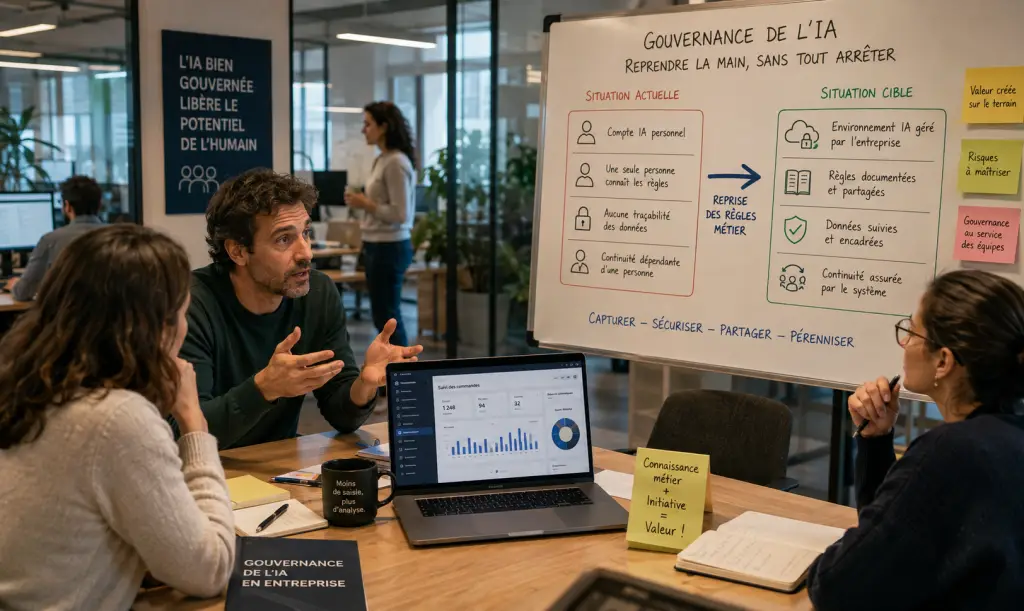
Furthermore, strict data governance is essential to ensure their security and prevent any risk of leakage or misuse. Cloud platforms like Snowflake play a key role here, by centralising data in secure environments while enabling its exploitation by AI models.
A vision for the future: AI as a driver of innovation in retail
Beyond the immediate benefits it offers today, generative AI represents a true engine of long-term innovation for the retail sector. Thanks to its capabilities in semantic analysis, summarisation, and even prediction of customer behaviour, it not only allows for the optimisation of existing processes but also fundamentally rethinks the way brands interact with their data, their employees, and their customers.
As Patrick Chable says: « We are only at the beginning of this revolution. Generative AI is not a magic wand, but a strategic tool which, used correctly, can transform retail professions. »
The future of AI in retail doesn't stop at automating tasks or improving productivity. She paves the way for new customer experiences., more personalised, more intuitive, and perfectly aligned with the expectations of a generation of consumers seeking immediacy and transparency. Imagine shops equipped with virtual assistants capable of guiding customers in real time, or fully autonomous supply chains where any stockout or delay is anticipated thanks to robust predictive models.
However, to take full advantage of these innovations, businesses will need to continue investing in a robust data governance and flexible platforms, capable of keeping pace with the rapid evolution of AI technologies. The collaboration between JEMS and Snowflake is a concrete example of this: by combining data management expertise with the power of cloud infrastructure, we are able to support our clients in this major transformation.
And you, how far can AI transform your processes? Whether you are at the beginning of your reflection or already well underway, the possibilities offered by these technologies are just waiting to be explored. Come discover how our experts can support you in tackling your challenges and shaping the future of retail together.