The Data Mesh promises the autonomy of business domains. Without a common heritage, without rules applied automatically, and without control over what is published, this autonomy produces the opposite: fragmented data, a Data Office overloaded, and Data Products that no AI use can consume with confidence.
Data governance: rules everywhere, a power that is elusive
Large companies have undoubtedly never invested as much in the governance of their data. Data Office, named data owners, catalogues, glossaries, quality tools and traceability tools, Data Mesh architectures, and now AI governance frameworks. Yet, the more the structure of the organization grows, the more a simple question becomes difficult to resolve: who actually controls the data assets, end-to-end?
With AI, this gray area is costly. Faced with incomplete data, an analyst fills in the gaps with his knowledge of the field. An agent, a copilote, or an assistant who draws on internal documents (RAG) spreads the approximation at the speed of the machine.
In February 2024, Gartner predicted that 80 % of the Data & Analytics governance initiatives would fail by 2027, because they were not linked to a real or triggered crisis that made them a priority. AI could well be that crisis. However, data governance for AI must demonstrate trust, and not just list the existing options.
Data Mesh: Three mechanisms that create unusable Data Products
Our diagnoses converge on three mechanisms that are intertwined: unstable heritage objects and divergent semantics; non-executable rules that centralize validations; Bronze/Silver/Gold layers reduced to storage and Data Products that reconstruct locally what the company thought it was meant to share.
Mechanism | What is happening | What the terrain shows | Consequence |
1. The chaos of urbanization | The domains are gaining in autonomy without a shared definition base or common reference framework. | Up to 340 variants of a «Customer» entity; €4.2 million per year in duplicate data flows; 18 to 23 % of the affected IT budget absorbed by redundant integrations (anonymized case). | Each cross-cutting project is aimed at reconciliation. The data remains attached to the projects rather than becoming a legacy. |
2. The illusion of governance | Nominated owners with no means; standards on paper; manual validations. | More than 200 pending requests, 8 to 12 weeks % of time delay, 71 refusals on the first submission (anonymized industrial program). | The Data Office remains responsible, but becomes the bottleneck that it was supposed to eliminate. |
3. The trap of layers | The Bronze, Silver and Gold layers are used to store data, not to measure their confidence level. | About 15 % are reused; 60 % are assets rebuilt locally; up to 40 % are additional incidents related to breaking changes, missteps, and unfulfilled commitments. | The platform is constantly circulating more data, without capitalizing on it or making it reliable. |
Source: field observations on 35+ programs analyzed since 2022. Case studies and anonymized figures: they illustrate recurring mechanisms and do not constitute market averages.
The most telling symptom concerns the Data Officer (CDO). He remains in place; the Data Office exists; the catalog is deployed. But semantics live in the business processes, models in the projects, flows in IT, and security, quality, and traceability capabilities in their respective tools. The CDO retains responsibility. Yet can he block the publication of an inauthentic asset, or immediately find the reference data, its users, and its exceptions? If the answer involves three teams and a committee, the power of action has left the center. Without anyone having decided so.
Giving more autonomy to domains does nothing unless that autonomy remains theoretical. Two scenarios then arise. Either the domain still depends on the center to publish, and the autonomy reduces to a circuit of approval. Or it bypasses the center, sets its own definitions and thresholds, and creates silos, federated this time.
Data governance for AI: making the rules executable
Large organizations no longer lack standards. The difference lies in the final mile, where a written rule becomes a behavior that is actually applied in the production of data.
In many programs, the rule becomes a checklist that is checked manually at the end of the project. It is checked after building rather than integrating the rule into design, testing, production, and operation. This has a counterintuitive effect: the more rules there are, the more reviews and escalations there are. In the industrial program of the table, the standards did indeed exist. They lacked precision, were not testable, and remained out of the teams’ daily routine.
Getting out of this impasse requires three decisions.
Writing rules that a machine can verify. Quality thresholds, access rights, update deadlines: everything that can be tested automatically must be tested. A rule that cannot be tested almost always ends up in a meeting.
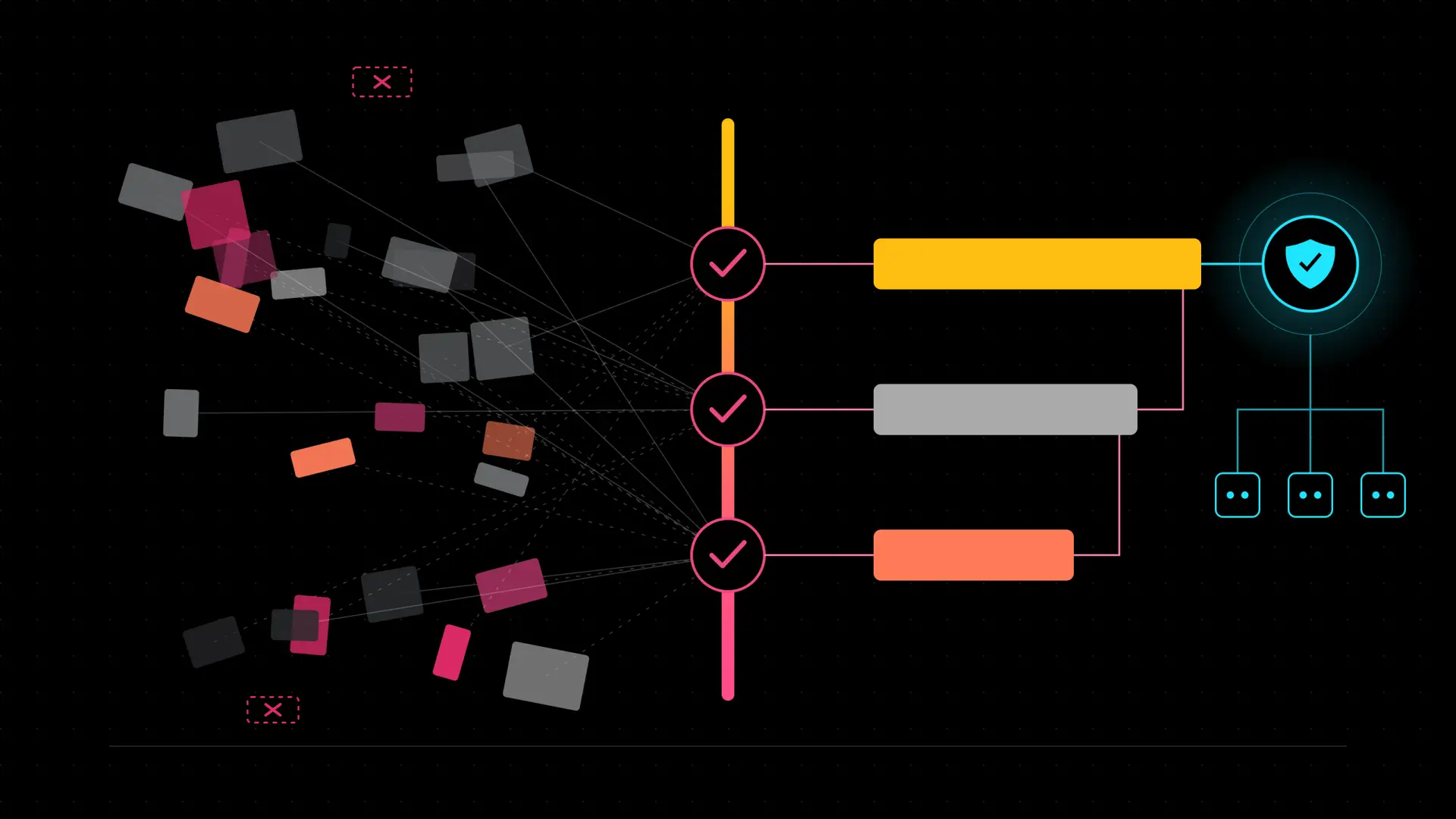
Control where the data is produced. Gartner recommends operating governance as close as possible to execution and designing scale-up by limiting escalations. The right measure of a federated organization then becomes the number of decisions a domain can make alone without damaging the common coherence, much more than the number of named owners.
Managing Data Products like a portfolio. A Data Asset Manager monitors the reuse, consistency of definitions, adoption, and the debt and withdrawal of assets. The Data Office sets the framework; the areas provide the meaning and value.
AI-ready data: Our conviction: the next frontier is the right to publish
At JEMS, our position is clear. The governance of tomorrow will be judged less by the number of objects catalogued than by its ability to decide what goes into the heritage, how it evolves, and what remains in it. The Data Office is not intended to approve every project: it sets the conditions of trust and arbitrates exceptions.
The question thus changes. Knowing whether a product is included in the catalogue is no longer enough; we need to know what evidence authorizes its publication and its reuse by other fields. Granting the right to publish means verifying a few explicit conditions:
- Sense : clear and shared definitions across domains
- Quality : measured reliability rather than declared reliability
- Security: controlled access and compliance
- Traceability The origin and the path of the data, from beginning to end
- Service commitments : levels of availability and freshness maintained over time
- Surveillance : continuous follow-up after publication
AI makes these conditions inevitable. According to Gartner (February 2025), 63 % organizations do not have, or do not know if they have, data management practices adapted to AI, and 60 % of private AI projects with AI-ready data will be abandoned by the end of 2026. Gartner also predicts that by 2028, half of organizations will adopt a «zero trust» attitude towards their data in the face of the influx of unverified and generated AI-generated content (January 2026).
For us, an AI-ready data set therefore involves the same effort: it is the level of maturity where the meaning, origin, and usage conditions of a Data Product are sufficiently clear for an agent to know whether they are allowed to use it.
Where are you with your data trust chain? → Exchange with an expert
Finally, give governance a layer of implementation
The Data Mesh lacks no good intentions. It runs into distributed responsibilities without means, standards that remain on paper, and publications that do not depend on any measurable level of trust. The next step consists neither in adding governance nor in decentralizing further, but in linking, in the production chain of each Data Product, definitions, commitments, controls, and proofs. The Data Office then regains real power, without becoming a mere gatekeeper.
Are your Data Products certified assets or disguised deliverables? The answer depends on the program. JEMS experts propose that you compare your governance model with these three mechanisms and identify what separates you from a truly AI-ready asset.
Examine your governance:
Exchange with the JEMS experts