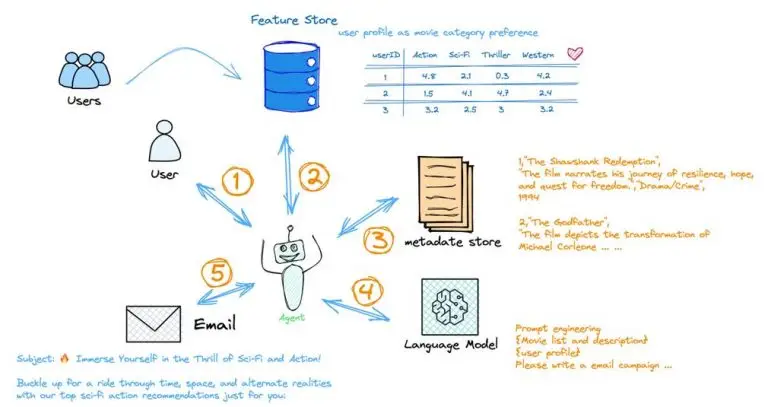
In the realm of artificial intelligence, the term «AI agents» is generating increasing interest, and rightly so. These agents are autonomous programs capable of perceiving their environment, making decisions, and acting on your behalf through generative AI algorithms. By combining data-driven analysis with agile automation, they promise more intelligent, faster, and flexible processes. In this article, we delve into the core of AI agents, their potential, real-world use cases, and how JEMS can help you implement this technology in your business.
What is an AI agent?
One AI Agent Or Software agent It's like an intelligent digital assistant. Imagine a small virtual robot that can read and understand information, chat with other computer systems, and accomplish tasks without you having to constantly monitor it. This robot uses advanced technologies like Machine learning to learn new things and improve over time, and the Natural Language Processing To understand and respond to questions in human language.
For example, consider an AI agent in a smart home. It can adjust the temperature, switch on the lights, and even order groceries online, all while communicating with other devices like your phone or your fridge. It makes autonomous decisions to make your life easier and more efficient, while collaborating with other agents to manage more complex tasks, such as home security or energy management.
Why software agents are important
Software agents are important for several reasons. Firstly, they help with Autonomous decision-making. Thanks to sophisticated algorithms and machine learning, these agents can analyse data, identify trends and make decisions without human intervention. For example, in the field of finance, a software agent can monitor stock markets and carry out transactions based on market conditions.
Next, the software agents adapt by Real time. They are capable of continuously collecting data, analysing it and adjusting in accordance with new information. For example, in a smart factory, software agents can monitor machines, detect anomalies and adjust production parameters to prevent breakdowns.
They also send User alerts. When a problem is detected or an action is required, agents can notify users via messages or notifications. For example, a software agent in a smart home might send an alert to your phone if a water leak is detected.
Software agents also increase efficiency by reducing repetitive tasks and human errors. They can automate tedious and repetitive tasks, allowing humans to focus on more complex and creative tasks. For example, in a customer service centre, a software agent can handle common requests, leaving human agents to deal with more complex cases.
inter-agent communication dynamic coordination. They collaborate to manage complex processes such as sensor network management, logistics flow optimisation, and the coordination of multi-agent systems in changing environments. For example, in a supply chain, software agents can work together to optimise the transport of goods, reduce costs, and improve delivery times.
They also have a capacity for’scalability. The deployment of new agents can be done without disrupting the existing system. This means that companies can easily add new features or improve the performance of their systems without having to rebuild everything. For example, an e-commerce company can add new agents to manage special promotions or periods of high demand without affecting the rest of the system.
In summary, software agents allow’Automate intelligently, and’optimise processes, and of manage complex systems in an adaptable and scalable manner. They represent a significant advancement in how businesses and technological systems function, offering gains in efficiency, accuracy, and flexibility.
How can JEMS's artificial intelligence team support you in developing agents within your company?
First and foremost, we are here to help you target your aims : We help you define applications where autonomous decision-making and coordination will bring significant added value. The second step is to Select the right tools Thanks to our partners such as Google or AWS, we identify the most relevant AI models and APIs. Then, we Let's test and iterate we start small, validate the solution with you, and improve the logic and coordination. The fourth and final step is the scale up Thanks to our teams, we enable you to industrialise your use cases for the long-term sustainability of the technology.
JEMS is present at every stage of your artificial intelligence product development. We support you from start to finish of the process and move quickly to save you time and enable you to respond to your needs as quickly as possible.
Ready to take the next step? Contact our AI team to discover how JEMS can support you in the design, implementation and evolution of tailor-made AI agent-based solutions.