Companies already have the knowledge. The problem has become access.
Every company today possesses considerable informational assets. Project documents, procedures, contracts, reports, presentations, knowledge bases, support tickets, technical documentation, or business content: knowledge often exists in abundance. However, in the majority of organisations, this information remains difficult to exploit.
Collaborators still spend a significant portion of their time on documentary research: looking for a procedure, finding a business definition, checking a business rule, identifying the correct document version, or understanding the reliability of information… This phenomenon is not new. However, the massive arrival of generative AI usage has profoundly changed user expectations.
Since the adoption of AI and conversational assistants, employees have become accustomed to receiving immediate, contextualised responses formulated in natural language. This evolution now creates a significant gap with companies' internal documentation systems.
On the one hand, personal uses are becoming fluid and conversational.
On the other hand, corporate documentary environments still largely rely on keyword search engines, complex SharePoint spaces, difficult-to-maintain hierarchical structures, or knowledge catalogues that are not easily accessible to business departments. The subject therefore goes far beyond simple “document searching”. It is becoming a strategic issue for AI itself.
Because an AI does not create knowledge. It exploits existing knowledge. And if this knowledge is fragmented, poorly managed, or difficult to access, the generated responses quickly become inaccurate, contradictory, or unreliable.
Companies are thus beginning to discover a crucial reality: the performance of an AI system depends directly on the quality and exploitability of the documentary heritage it relies upon.
Why traditional document search engines are no longer sufficient.
For a long time, companies have approached document retrieval as a primarily technical subject. The objective was to enable users to find a document based on a keyword, filename, author, date, or location in a tree structure.
This logic is reaching its limits today.
Why? Because users are no longer just looking for documents. They are looking for answers. Let's take a concrete example.
A colleague doesn't necessarily want to find an 80-page PDF on a compliance procedure. They want to understand immediately:
“What are the applicable rules in my specific case?”
Similarly, a business lead doesn't want to analyse multiple files to understand a metric. They want a clear explanation:
“Why does this figure differ from the previous reporting?”
This change appears simple. In reality, it completely transforms the way documentary systems need to function.
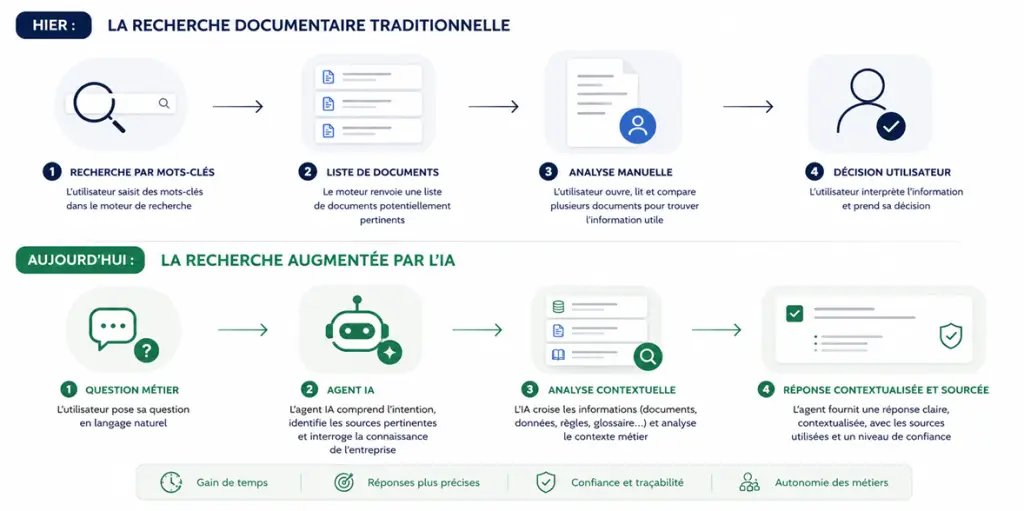
Traditional engines rely primarily on a matching logic with a keyword, an index, and an associated document.
AI usage, on the other hand, relies on a logic of understanding: user intent, business context, links between information, level of trust, and the ability to provide an actionable response. This is where the limitations of current systems become apparent.
In many companies, documents are scattered, metadata is incomplete, business definitions are not standardised, business rules remain implicit, and links between data, documents, and uses are weak.
Result: even the best generative AI models produce brittle responses if the informational heritage is not structured correctly.
Classic document retrieval vs. AI-augmented search
| Classic literature search |
AI-powered augmented search |
| Keyword search |
Questions in natural language |
| Access to documents |
Access to contextualised answers |
| Document logic |
Business logic |
| Poorly contextualised results |
Contextualised and sourced answers |
| Reliance on expert users |
Extended accessibility to trades |
| Manual navigation |
Conversational interaction |
AI is transforming the relationship with business knowledge
The rise of LLMs is gradually transforming how organisations view their documentary heritage. For a long time, the value of a documentary base primarily rested on its storage and classification capabilities. Today, the value is shifting towards the ability to activate this knowledge intelligently. This change is significant.
A company no longer just creates repositories. It is gradually building a system capable to understand business questions, to identify the right sources, to link data and documents, to decontextualise the answers, and explain the associated confidence level.
In other words, documentary research becomes a subject of governance and knowledge exploitation. The role of AI agents becomes particularly interesting here.
Unlike a classic document engine, an AI agent can interpret a business request, analyse the context, cross-reference multiple sources, provide a synthetic response, and explain its reasoning. However, this capability is directly dependent on the quality of the informational foundations.
This is one of the most frequent misunderstandings surrounding generative AI in business. Many organisations believe that the model itself constitutes the main value. In reality, the real differentiator often becomes the quality of accessible knowledge, their governance, their structuring, and their business contextualisation.
Without this, its uses remain limited. The most advanced companies are therefore beginning to reposition their documentary projects around a much more strategic logic: no longer simply storing information, but making knowledge exploitable on a large scale.
How to make documentary research truly useful for trades/professions?
Organisations that successfully achieve their document transformation generally share several common characteristics.
They think use before tool
Many documentary projects have long been conceived as technical projects: documentary migration, document management, SharePoint structuring, indexing or archiving.
These dimensions remain important. But they are no longer sufficient.
The most effective approaches now stem from business uses: operational support, onboarding, compliance, customer relations, maintenance, or decision support.
The documentation system then becomes a knowledge infrastructure usable by AI.
They link documents, data and business context.
The main problem with current systems is often fragmentation. Data exists on one side. Documents on another. Business rules elsewhere. Yet, a user never thinks in silos.
When he asks a question, he expects an answer capable of linking data, documents, rules, definitions, and operational uses. This ability to contextualise is becoming one of the major challenges of the coming years.
They incorporate trust into the responses
One of the major risks of AI usage remains the loss of trust.
A quick but false answer can have a considerable impact on compliance, operations, decisions, or customer relations.
Companies must therefore be able to provide the sources used, the confidence level, the lineage, and the context associated with each answer.
Evolution of documentary research
Documentary research is becoming a subject of competitiveness
Businesses have long considered documentation a support topic. With generative AI, it is gradually becoming a strategic asset. Why? Because the ability to quickly access the right knowledge now directly influences execution speed, decision quality, business autonomy, and the ability to industrialise AI.
This evolution will likely profoundly transform organisations in the coming years. The companies that truly create value with AI will not necessarily be those with the most advanced models. They will be those capable of making their knowledge assets usable, contextualised, and reliable. The subject is therefore no longer solely technological. It is becoming cognitive, organisational, and strategic. AI does not replace business knowledge. It amplifies the ability to exploit it.
And it is precisely for this reason that document governance, lineage, and knowledge structuring are taking on a new importance today. In the long term, the boundary between search engines, data catalogues, document repositories, and AI assistants will progressively disappear.
The most mature organisations will no longer build separate tools, but genuine knowledge systems capable of understanding business context, orchestrating multiple sources and delivering immediately actionable information.
This evolution marks probably one of the most significant transformations in the use of data and AI in business.
Towards a new generation of knowledge systems
Traditional document search engines were designed for file retrieval. New AI uses now require systems capable of understanding, contextualising, and delivering business knowledge in a usable way.
This evolution marks a significant break in how companies approach their information assets.
At JEMS, we support organisations in this transformation by designing systems capable of linking data, documents, governance, and AI usage to make knowledge truly actionable for business units.
The goal is no longer simply to access information, but to enable employees to interact naturally with the company's knowledge base through AI.
To find out more, also discover the JEMS IA DataKnowledge approach, developed around the intelligent exploitation of company knowledge: